
High energy density, long-endurance and reliable lithium battery solutions for industrial inspection UAVs, security surveillance drones, thermal imaging drones and autonomous monitoring platforms.
LithoTop develops custom LiPo and Li-ion battery packs for inspection and surveillance drones requiring extended flight endurance, stable voltage output, lightweight construction and reliable power delivery during continuous monitoring operations.
Inspection and surveillance drones are widely used in infrastructure maintenance, industrial asset monitoring, security operations, public safety, energy facilities and remote environmental observation.
Unlike recreational drones, professional inspection UAVs frequently carry specialized equipment such as thermal cameras, high-resolution zoom cameras, LiDAR sensors, gas detectors, communication modules and onboard AI processors.
These aircraft may perform repeated inspection routes, stationary hovering, autonomous patrols or extended monitoring missions in challenging outdoor environments.
Battery performance directly influences flight endurance, payload capability, voltage stability, mission continuity and safe return-to-home operations.
LithoTop provides customized lithium battery solutions based on aircraft power consumption, sensor payload requirements, mission duration, discharge profiles, battery installation space and environmental conditions.
Custom lithium battery solutions for industrial inspection, infrastructure monitoring, security patrols, and autonomous UAV operations.
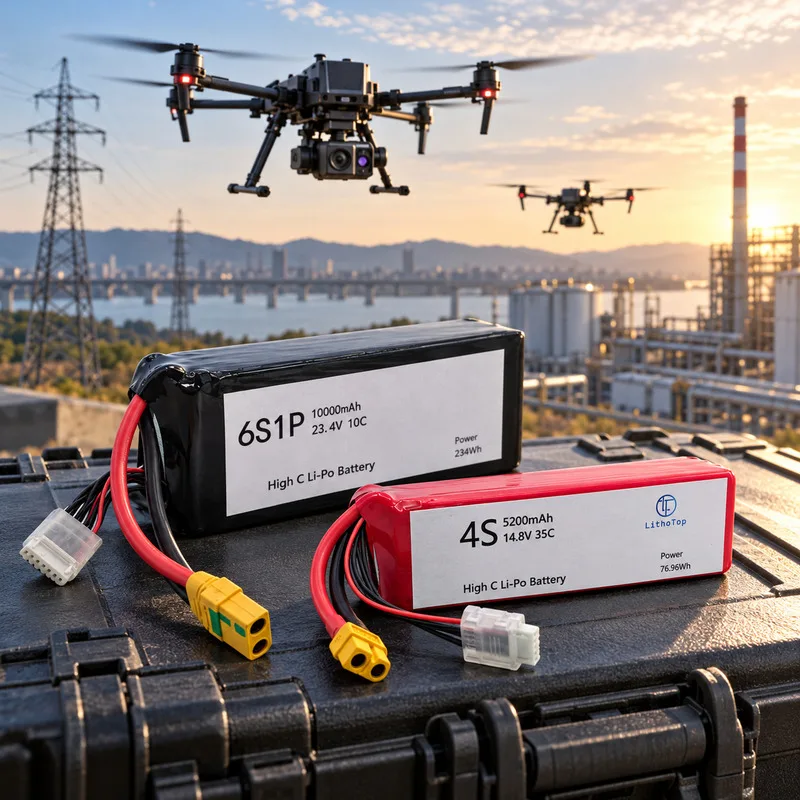
Battery selection depends on aircraft weight, sensor payload, propulsion demand, mission duration, current requirements and available installation space.
Providing complete application data helps LithoTop evaluate cell chemistry, configuration, current capability and mechanical structure more accurately.
| Parameter | Typical Customization Range |
|---|---|
| Nominal Voltage | 7.4V–51.8V or Custom |
| Configuration | 2S–14S or Custom |
| Capacity | 2,000mAh–40,000mAh or Custom |
| Battery Chemistry | High Energy LiPo / High-Rate LiPo / High-Voltage LiPo / Li-ion |
| Cell Platform | Pouch / 18650 / 21700 |
| Continuous Discharge Rate | 3C–30C Depending on Cell Platform |
| Peak Discharge Current | Customized According to Flight Load |
| Charging | Standard / Fast Charging Optional |
| Smart Monitoring | Optional |
| Protection / BMS | According to Battery Architecture |
| Communication | CAN / UART / SMBus / Custom Optional |
| Temperature Sensor | NTC Optional |
| Housing | Heat Shrink / Plastic / Composite / Custom |
| Connector | XT60 / XT90 / AS150 / Custom |
| Battery Replacement | Swappable / Fixed Installation |
| Operating Temperature | Standard / Low-Temperature Options |
* Custom Lipo Battery from LithoTop Now !
Send us your UAV voltage, load current, peak current, target flight time, battery dimensions and weight limit. LithoTop will evaluate a suitable battery configuration for your project.
Inspection drones commonly use high-energy LiPo, high-rate LiPo, high-voltage LiPo, or cylindrical Li-ion batteries. LiPo batteries provide the discharge power required by multirotor and VTOL drones, while 18650 or 21700 Li-ion packs may offer higher energy density for efficient, long-endurance inspection platforms.
The best battery depends on the aircraft type, propulsion power, payload, and flight profile. High-energy 18650 or 21700 Li-ion packs are often suitable for efficient fixed-wing UAVs, while high-energy or high-voltage LiPo batteries may be better for multirotor and VTOL surveillance drones requiring higher current. The final design must balance runtime, weight, voltage, discharge capability, safety, and available installation space.
Yes. LithoTop can customize batteries for drones equipped with thermal cameras, infrared sensors, stabilized gimbals, onboard processors, and communication systems. The battery design can be developed according to the payload power demand, required flight time, aircraft voltage, continuous and peak current, dimensions, weight limit, connector, and operating environment.
Yes. LithoTop can develop custom battery solutions for power line inspection UAVs carrying optical cameras, thermal cameras, LiDAR, zoom systems, and transmission equipment. Battery selection should consider hover time, route distance, wind conditions, inspection payload, peak propulsion current, electromagnetic environment, and the required return-to-home reserve.
Yes. The battery system can support UAVs integrating LiDAR, thermal cameras, gas sensors, multispectral sensors, zoom cameras, RTK/GNSS receivers, and onboard computers. Total power consumption, voltage stability, peak current, electrical interfaces, grounding, filtering, and power distribution should be evaluated with the complete UAV electrical architecture.
Yes. Depending on the battery architecture, LithoTop can evaluate smart monitoring functions such as voltage, current, temperature, state-of-charge data, cell balancing, fault reporting, and communication through CAN, UART, SMBus, or a customized protocol. Final functions must be matched with the UAV controller and charging system.
Yes. Batteries for drone-in-a-box systems can be designed around autonomous charging, frequent missions, standby periods, charging contacts, battery replacement method, communication, temperature monitoring, and enclosure conditions. The charging station, aircraft battery interface, duty cycle, and environmental requirements must be evaluated together.
Yes. LithoTop can evaluate high-voltage LiPo batteries for inspection UAVs requiring increased energy within limited weight and battery space. Cell voltage, series configuration, charger compatibility, discharge current, cutoff settings, temperature, cycle-life target, and aircraft controller compatibility must be confirmed during engineering development.
Yes. Low-temperature battery options can be evaluated for inspection and surveillance drones operating in winter, mountain, high-altitude, or northern environments. The design depends on the minimum operating temperature, required discharge current, charging temperature, storage conditions, insulation, preheating strategy, and target flight duration.
Please provide the required voltage and capacity, aircraft type, target flight time, average and peak current, propulsion system, inspection payload, available battery dimensions, maximum weight, connector, wire length, charging method, operating temperature, battery replacement method, protection or communication requirements, certification market, and estimated order quantity. Flight logs and power-consumption data are also helpful.

LithoTop | Battery Expert
Online
Hi! Welcome to LithoTop.
Please send your specs for an instant solution:
1. Dimensions (T*W*L)
2. Voltage & Capacity
3. Peak Current
I'm online to help you now!
— Caroline | LithoTop
WhatsApp Us
Online | Privacy policy
WhatsApp us
Response within 12 hours. Save up to 30% on bulk orders.
🔒 100% Privacy. No Hidden Costs. Free Sample Options.