
Compact, long-standby and reliable lithium battery solutions for wireless sensors, IoT devices, environmental monitoring and industrial sensor systems.
LithoTop develops customized rechargeable and primary batteries for sensor devices requiring compact dimensions, ultra-low standby consumption, long service life and reliable wireless communication.
Sensors are increasingly integrated into smart homes, industrial equipment, medical devices, logistics systems, agriculture, environmental monitoring and distributed IoT networks.
Modern sensor systems may combine temperature, humidity, pressure, vibration, gas, motion or positioning sensors with Bluetooth, Zigbee, Thread, Matter, LoRa, NB-IoT, LTE-M or Wi-Fi communication modules.
Many sensor nodes remain in sleep mode for most of their operating life and wake periodically to measure, process and transmit data. This makes standby consumption, battery self-discharge and wireless pulse-current performance especially important.
LithoTop provides ultra-small LiPo batteries, ultra-thin LiPo batteries, high energy density LiPo batteries, cylindrical Li-ion packs and Li-MnO₂ primary batteries for sensor and IoT applications.
Customized battery solutions for environmental sensing, industrial monitoring, smart buildings, healthcare, logistics, agriculture and remote IoT networks.
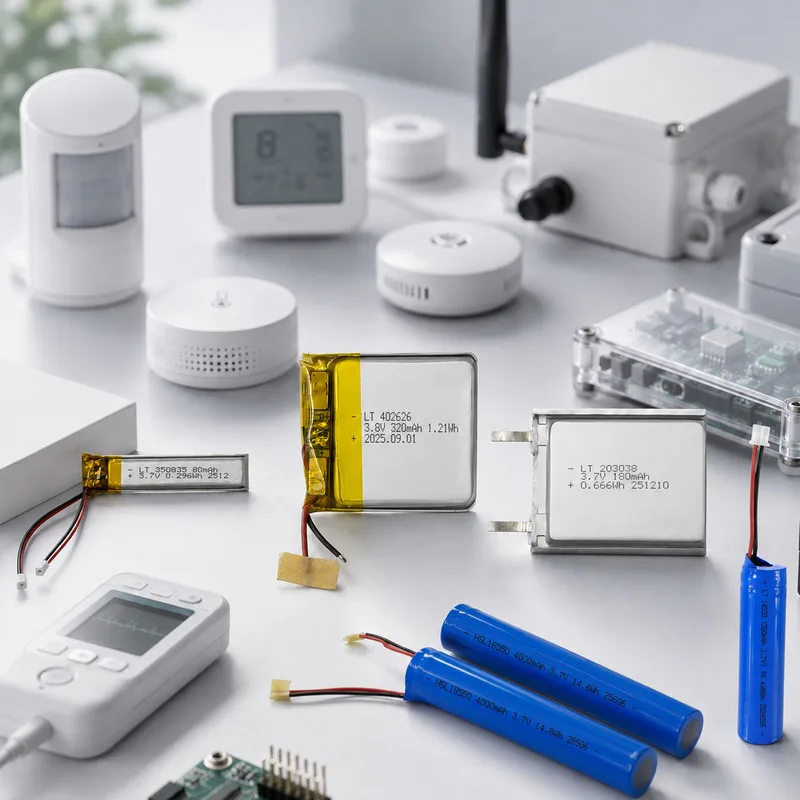
Battery selection depends on sensor dimensions, standby consumption, wireless communication load, target service life, environmental conditions and whether the system is rechargeable.
Providing complete application data helps LithoTop evaluate cell chemistry, configuration, current capability and mechanical structure more accurately.
| Parameter | Typical Customization Range |
|---|---|
| Nominal Voltage | 3.0V / 3.6V / 3.7V / 3.8V / 7.4V |
| Capacity | 20mAh–20,000mAh |
| Battery Chemistry | LiPo / High-Voltage LiPo / Li-ion / Li-MnO₂ |
| Battery Type | Rechargeable / Primary |
| Configuration | 1S–2S or Custom |
| Thickness | Approx. 1.0mm and Above for LiPo |
| Standby Support | Optimized for Ultra-Low Power Devices |
| Pulse Current | Customized for Wireless Communication and Sensor Loads |
| Protection | PCM / BMS Optional |
| Temperature Sensor | NTC Optional |
| Fuel Gauge | Optional |
| Communication | UART / SMBus Optional |
| Connector | JST / Molex / FPC / Tab / Custom |
| Housing | Heat Shrink / Plastic / Sealed Custom Housing |
| Certification Support | UN38.3 / MSDS / IEC 62133 / CE / RoHS |
Actual battery capacity and service life must be confirmed according to sleep current, sensor sampling interval, wireless transmission frequency, pulse current, operating temperature and required maintenance interval.
* Custom Lipo Battery from LithoTop Now !
Send us your available battery dimensions, sleep current, sensor current, wireless communication type, transmission peak current, reporting interval, target service life and operating temperature. LithoTop will evaluate a suitable battery solution for your project.
Rechargeable sensors commonly use LiPo or Li-ion batteries, while low-power sensors requiring long service life may use Li-MnO₂ primary batteries.
The best battery depends on standby current, wireless transmission current, reporting frequency, available space, target service life and rechargeability. The battery should be selected according to the complete sensor duty cycle.
Wireless modules may require short current peaks during data transmission. Stable pulse-current output helps prevent voltage drop, failed communication and unexpected device resets.
Yes. LithoTop can optimize battery chemistry, capacity, self-discharge performance, PCM consumption and pulse-current capability according to the sensor duty cycle and required deployment time.
Yes. Li-MnO₂ primary batteries can be well suited to low-power sensors requiring low self-discharge, long storage life, extended maintenance intervals and no charging circuit.
Yes. LithoTop can customize LiPo battery dimensions, capacity, terminal layout, wire length, connector and protection circuit for miniature sensors and other compact electronic devices.
Battery performance depends on the chemistry, load profile and required temperature range. LithoTop can evaluate low-temperature battery solutions for outdoor, cold-chain and industrial sensor applications.
Yes. Battery capacity, pulse-current output and protection settings can be optimized according to the LoRa, Zigbee, BLE, NB-IoT or other wireless communication module and its transmission-current profile.
Please provide voltage, available battery dimensions, sleep current, sensor operating current, communication peak current, reporting interval, target runtime, connector and operating temperature. Device drawings and estimated order quantity are also helpful for engineering evaluation.

LithoTop | Battery Expert
Online
Hi! Welcome to LithoTop.
Please send your specs for an instant solution:
1. Dimensions (T*W*L)
2. Voltage & Capacity
3. Peak Current
I'm online to help you now!
— Caroline | LithoTop
WhatsApp Us
Online | Privacy policy
WhatsApp us
Response within 12 hours. Save up to 30% on bulk orders.
🔒 100% Privacy. No Hidden Costs. Free Sample Options.