
High energy density, long-endurance and reliable lithium battery solutions for aerial mapping drones, surveying UAVs, LiDAR platforms and professional geospatial data collection systems.
LithoTop develops custom LiPo and Li-ion battery packs for mapping and surveying UAVs requiring long mission endurance, lightweight construction, stable voltage output and reliable performance during continuous aerial data acquisition.
Mapping and surveying UAVs are widely used in land surveying, construction, infrastructure inspection, mining, agriculture, environmental monitoring and geospatial data collection.
Unlike conventional photography drones, professional surveying UAVs often follow predefined flight routes, maintain specific altitude and speed profiles, and operate specialized mapping payloads continuously throughout the mission.
These platforms may integrate RTK/GNSS receivers, LiDAR scanners, photogrammetry cameras, multispectral sensors, thermal cameras, onboard data processors and long-range communication equipment. Reliable power delivery is essential for completing planned mapping missions and maintaining consistent data acquisition.
LithoTop provides custom UAV battery solutions designed around aircraft power consumption, surveying payload weight, target mission duration, operating conditions and battery installation constraints.
Custom lithium battery solutions for professional mapping, geospatial surveying, LiDAR scanning, and long-endurance aerial data collection.
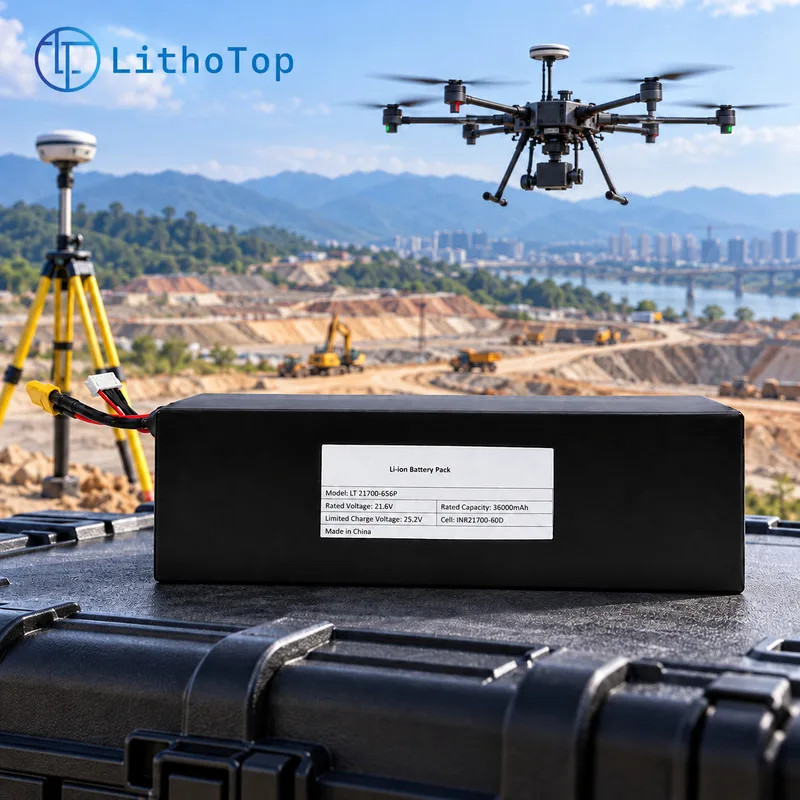
Battery selection depends on aircraft configuration, surveying payload, propulsion demand, target flight time, available space and maximum battery weight.
Surveying drone battery capacity should be evaluated according to the complete mapping mission rather than nominal capacity alone. Aircraft propulsion, sensor loads, flight route, environmental conditions and reserve energy all influence the required battery configuration.
| Parameter | Typical Customization Range |
|---|---|
| Nominal Voltage | 7.4V–51.8V or Custom |
| Configuration | 2S–14S or Custom |
| Capacity | 2,000mAh–40,000mAh or Custom |
| Battery Chemistry | High Energy LiPo / High-Rate LiPo / High-Voltage LiPo / Li-ion |
| Cell Platform | Pouch / 18650 / 21700 |
| Continuous Discharge Rate | 3C–30C, Depending on Cell Platform |
| Burst Discharge Rate | Customized According to Peak Flight Load |
| Continuous Current | Customized According to Aircraft Power |
| Peak Current | Customized for Takeoff, Climb and VTOL Transition |
| Charging | Standard / Fast Charging Optional |
| Protection / Monitoring | Optional According to UAV Architecture |
| Communication | CAN / UART / SMBus / Custom Optional |
| Temperature Sensor | NTC Optional |
| Housing | Heat Shrink / Plastic / Composite / Custom |
| Connector | XT60 / XT90 / AS150 / Custom |
| Low-Temperature Option | Available According to Project Requirements |
* Custom Lipo Battery from LithoTop Now !
Share your aircraft configuration, LiDAR or camera payload, propulsion specifications, average and peak power, target mission duration, battery dimensions and maximum battery weight. LithoTop will evaluate a custom lithium battery solution balancing energy density, mission endurance, voltage stability and reliable UAV operation.
Mapping and surveying UAVs commonly use high-energy LiPo batteries, high-voltage LiPo batteries, or cylindrical Li-ion battery packs. LiPo batteries provide strong discharge performance for multirotor and VTOL aircraft, while 18650 or 21700 Li-ion packs can offer higher energy density for fixed-wing and long-endurance surveying UAVs.
Battery capacity should be calculated from the aircraft’s average power consumption and target flight time. A basic estimate is: required energy (Wh) = average power (W) × flight time (hours). The result should then be adjusted for usable depth of discharge, reserve flight time, payload weight, wind, temperature, battery aging, and takeoff or VTOL power demand.
The best choice depends on the aircraft and mission profile. High-energy 18650 or 21700 Li-ion packs are often suitable for efficient fixed-wing UAVs, while high-energy or high-voltage LiPo batteries may be better for multirotor and VTOL platforms that require higher discharge current. The final battery should balance energy density, weight, current capability, voltage, safety, and available installation space.
Yes. LithoTop can develop custom battery solutions according to the LiDAR payload, propulsion system, onboard processor, flight duration, operating voltage, continuous current, peak current, connector, housing, and communication requirements. The design can also consider the additional power demand created by continuous LiDAR scanning and data processing.
Yes. LithoTop can customize lightweight, high-energy battery packs for fixed-wing mapping UAVs. Depending on the required endurance and current profile, the solution may use LiPo pouch cells or 18650/21700 Li-ion cells, with customized voltage, capacity, dimensions, wiring, connector, protection, and housing.
Yes. VTOL surveying UAV batteries can be designed to support both high-current vertical takeoff and efficient forward flight. Battery selection should account for takeoff, climb, transition, cruising, landing, payload power, peak current, target mission duration, and the required safety reserve.
Yes. The battery system can be configured to power UAV platforms equipped with RTK receivers, GNSS modules, flight controllers, mapping cameras, telemetry systems, and onboard computers. Stable voltage delivery, electrical integration, grounding, filtering, and power-distribution design should be confirmed with the aircraft electronics team.
Yes. LithoTop can evaluate high-voltage LiPo battery solutions for mapping UAV projects requiring greater energy within a limited weight and installation space. Cell voltage, series configuration, charger compatibility, discharge current, cutoff settings, thermal behavior, and cycle-life targets must be confirmed during engineering evaluation.
Yes. Low-temperature battery options can be evaluated for surveying UAVs operating in winter, mountains, high-altitude regions, or other cold environments. The design depends on the minimum operating temperature, required discharge current, flight time, preheating conditions, charging temperature, insulation, and aircraft power requirements.
Please provide the required voltage and capacity, target flight time, average and peak current, motor and propulsion information, aircraft type, mapping payload, available battery dimensions, maximum battery weight, connector, wire length, charging method, operating temperature, protection or communication requirements, certification market, and estimated order quantity. Flight logs or power-consumption data can further improve battery selection.

LithoTop | Battery Expert
Online
Hi! Welcome to LithoTop.
Please send your specs for an instant solution:
1. Dimensions (T*W*L)
2. Voltage & Capacity
3. Peak Current
I'm online to help you now!
— Caroline | LithoTop
WhatsApp Us
Online | Privacy policy
WhatsApp us
Response within 12 hours. Save up to 30% on bulk orders.
🔒 100% Privacy. No Hidden Costs. Free Sample Options.