When clients contact us asking for smart ring batteries, the first question they usually ask is: "Can you make it smaller and last longer?" I understand the frustration—everyone wants a ring that tracks health metrics 24/7 without charging every day, but nobody wants a bulky device on their finger. The pressure to deliver both keeps growing, and buyers often assume newer battery materials automatically solve the size-versus-runtime problem.
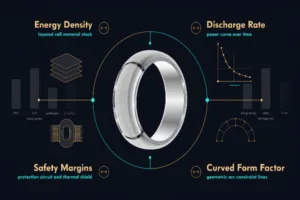
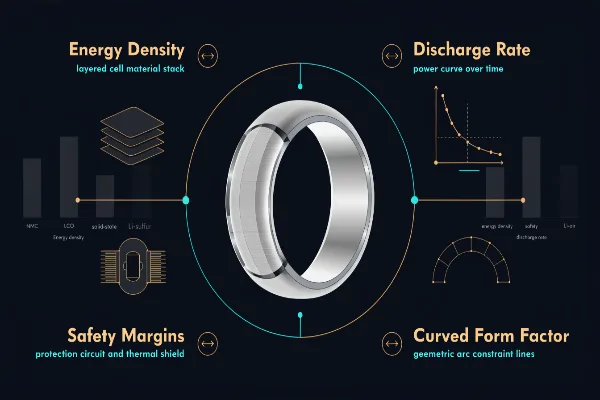
Smart ring batteries appear smaller and more powerful because designers are balancing multiple trade-offs—energy density improvements, safety margins, discharge rate requirements, and curved form factor constraints—rather than relying on a single material breakthrough. The real question isn't which material is "best" but which combination of design choices fits your application's usage pattern and safety requirements.
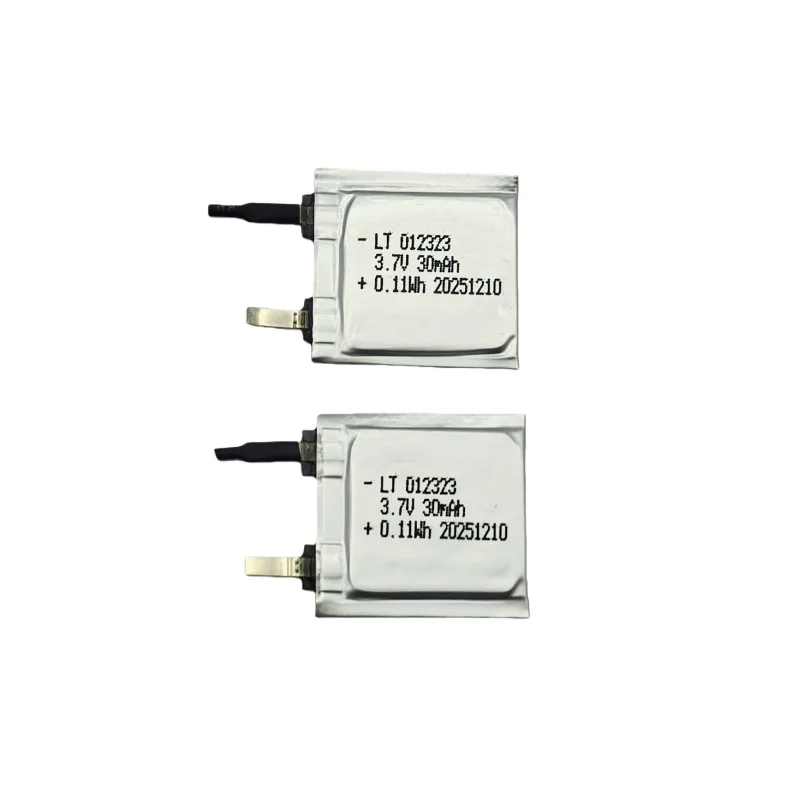
Last month, a wearable brand sent us specs for a ring battery: 25mm diameter, 2mm thickness, curved shape, and they wanted 40mAh capacity. They assumed this was straightforward because they'd seen marketing materials claiming "ultra-high energy density cells." When we reviewed their power consumption profile, we realized the battery would need to deliver peak current during sensor polling while fitting a curve radius that limits internal layer stacking. The conversation shifted from "give us the highest capacity" to "help us define which trade-offs we can accept." That's the reality behind every smart ring battery that looks smaller but works longer.
What Actually Makes Smart Ring Batteries Shrink?
Most buyers assume battery size shrinks because of better materials—higher energy density cells that pack more milliamp-hours into less space. That's partially true, but it skips over the engineering decisions that determine whether a high-density cell will actually work in a ring.
Smart ring batteries shrink when designers successfully negotiate between energy density gains, safety certification limits, structural durability in curved shapes, and real-world power draw patterns. Material improvements enable smaller sizes, but design constraints decide what's feasible.
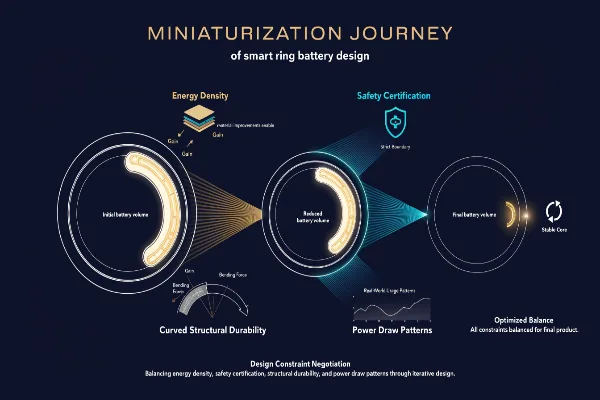
When we evaluate a custom ring battery request, we map four variables that all push against each other: the physical space available, the capacity target, the discharge rate the sensors require, and the safety margin needed to pass drop tests and thermal cycling. Energy density improvements from newer cell chemistries give us more room to work with, but they don't eliminate the other constraints.
How Energy Density Gains Translate to Real Projects
Energy density measures how much energy you can store per unit volume or weight. Lithium polymer batteries used in smart rings have seen gradual energy density increases over the past five years—moving from around 400 Wh/L to 600+ Wh/L in some configurations. That sounds like a 50% improvement, which should let you shrink the battery by 50%, right?
Not quite. Here's what happens in practice:
| Variable | How It Limits Shrinkage | Real Project Impact |
|---|---|---|
| Safety margin | Higher energy density cells pack more energy into the same space, which increases thermal runaway risk if the cell is punctured or overcharged. We need thicker separator layers or lower charge voltage limits to maintain safety. | A 30mAh cell at 600 Wh/L may need the same physical size as a 25mAh cell at 500 Wh/L after adding safety buffer. |
| Discharge rate | Smart rings often need pulse currents when sensors activate (e.g., heart rate LED, accelerometer polling). Higher energy density cells sometimes have lower rate capability, meaning they can't deliver the current spikes without voltage sag. | We've delivered projects where the client accepted 5% less capacity to use a cell chemistry that handles 2C discharge rates reliably. |
| Curved form factor | Rings require batteries that bend or fit irregular interior shapes. Curving a battery means using thinner individual layers and more flexible packaging, which reduces the volume efficiency compared to a flat rectangular cell. | A curved 20mAh battery may occupy the same envelope as a flat 25mAh battery because the curve wastes space at the edges. |
| Cycle life under stress | Smaller batteries in rings experience more charge-discharge cycles per day (because capacity is limited) and undergo more mechanical flexing from hand movements. Higher energy density cells sometimes degrade faster under these conditions. | We test cycle life at the actual curve radius and temperature range the ring will see. A cell that works well flat may fail at 500 cycles when curved. |
I've seen buyers focus entirely on the nominal capacity number—"I need 30mAh in this space"—without asking about discharge rate or cycle life. Then they're surprised when the battery doesn't last through a full day of sensor polling or fails after six months of use. Energy density is one input, not the entire solution.
Why Capacity Numbers Don't Predict Runtime?
Here's a scenario we encounter often: a client compares two ring batteries, one rated 20mAh and another rated 30mAh, and assumes the 30mAh version will last 50% longer. Then they test both in their ring, and the 20mAh battery actually outlasts the 30mAh one. They contact us confused, thinking one of the capacity ratings was wrong.
A battery's capacity rating measures total energy storage under ideal lab conditions, but runtime depends on how efficiently the ring's circuitry uses that energy, how much current the sensors draw during active periods, and how well the battery delivers power at the required discharge rate.
What Happens Between Capacity and Runtime
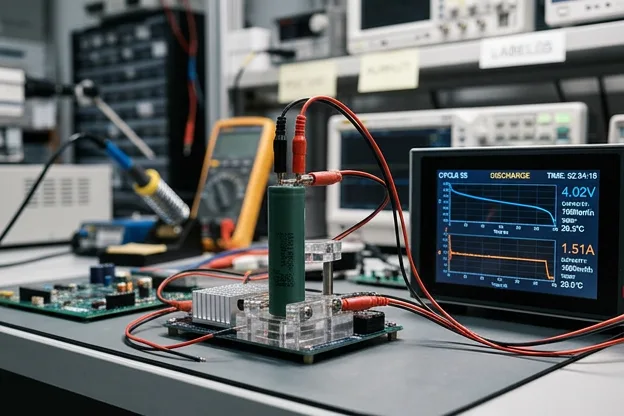
Capacity (measured in milliamp-hours) tells you how much charge the battery holds when discharged at a standard low rate (usually 0.2C) down to a cutoff voltage (typically 3.0V). But smart rings don't discharge at steady low rates—they sit idle most of the time (drawing microamps in standby) and then spike to several milliamps when sensors activate.
Here's what affects runtime in real use:
| Factor | How It Reduces Usable Capacity | Example Impact |
|---|---|---|
| Voltage cutoff mismatch | The ring's power management IC may shut down at 3.2V to protect components, but the battery still has 10-15% capacity between 3.2V and 3.0V. That capacity never gets used. | A 25mAh battery effectively becomes 21-22mAh if the system cuts off early. |
| High-rate voltage sag | When sensors draw peak current, the battery's voltage drops temporarily. If it sags below the cutoff threshold, the system shuts down even though the battery isn't empty. | We've tested cells where voltage sags to 3.1V during a 50mA pulse, causing premature shutdown despite 30% capacity remaining. |
| Standby drain | The ring's Bluetooth module, memory, and sensor standby circuits draw continuous current (often 50-200µA). Over 20 hours of idle time, this can consume 1-4mAh before the user even takes a measurement. | A ring with 100µA standby drain loses 2.4mAh per day just staying connected. That's 10% of a 25mAh battery. |
| Temperature derating | Battery capacity drops at low temperatures. If the user wears the ring outdoors in winter, the effective capacity may fall by 10-20%[^1]. | A 30mAh battery at 0°C may deliver only 24-27mAh. |
I worked on a project where the client's ring was rated for "7 days of battery life" based on lab tests with a 30mAh battery. Users complained it lasted only 3-4 days. We discovered their Bluetooth firmware was polling for connections every 2 seconds instead of every 10 seconds, tripling standby current. The battery wasn't the problem—the power budget was. Capacity matters, but runtime comes from the entire system.
How Do Curved and Ultra-Thin Designs Change Battery Performance?
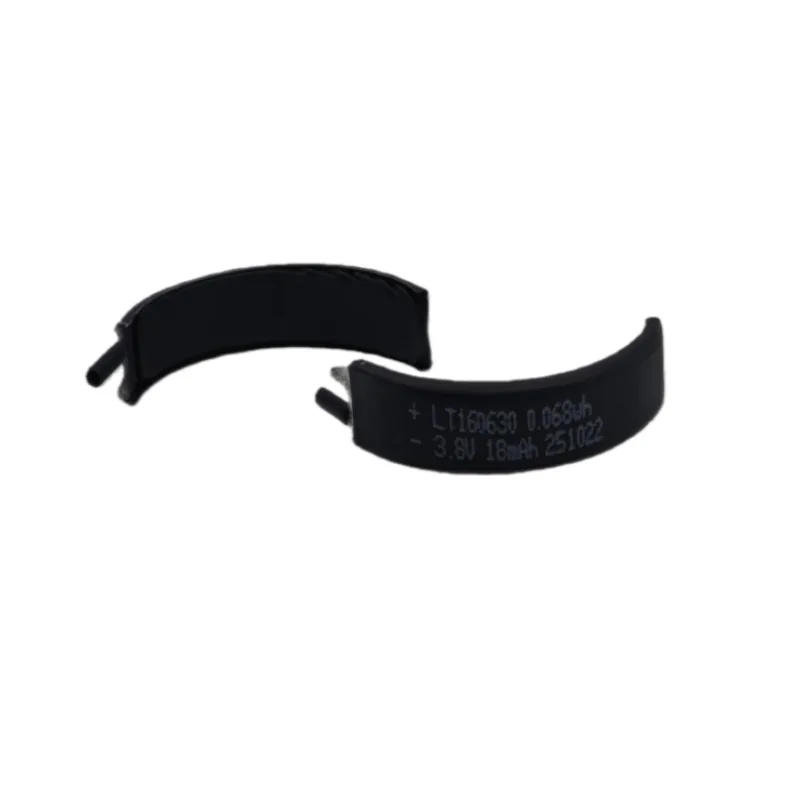
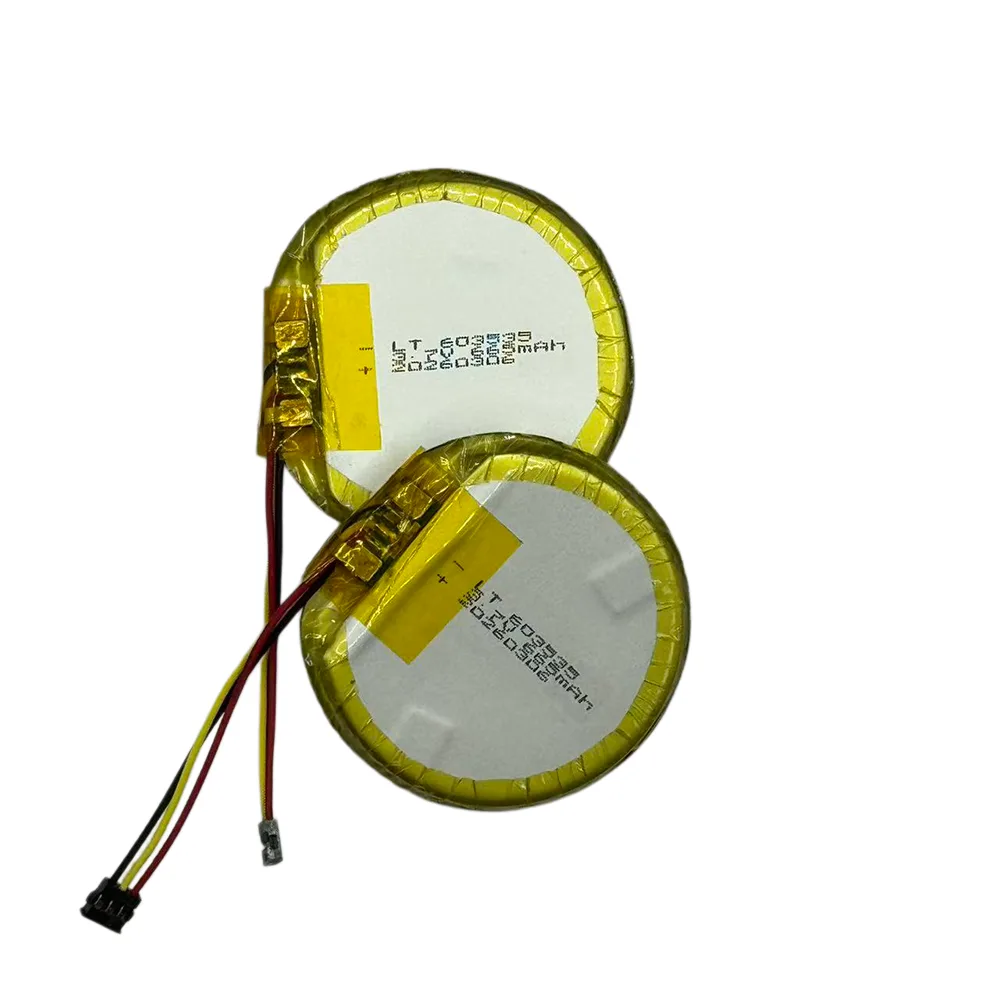
Smart rings force batteries into shapes that would never exist in a smartphone or laptop. The battery has to curve to follow the ring's inner circumference, fit within 1.5-3mm of thickness, and survive being flexed every time the user moves their hand. These constraints aren't just manufacturing challenges—they directly affect how much energy you can store and how long the battery lasts.
Curved and ultra-thin battery designs reduce volumetric efficiency, limit the number of internal layers you can stack, and introduce mechanical stress that accelerates capacity fade. These trade-offs mean a curved 20mAh battery may occupy the same space as a flat 28mAh battery and degrade faster under real-world use.
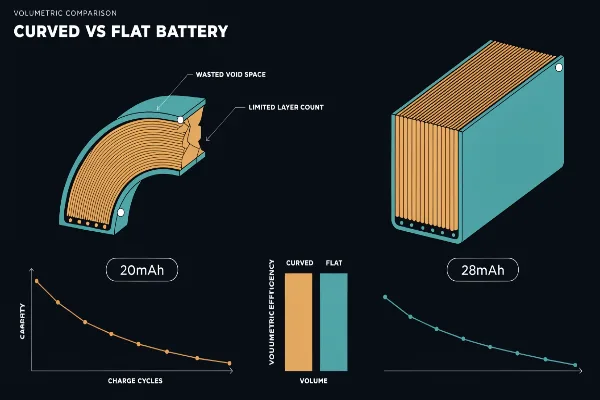
When we design a curved battery, we start by defining the bend radius—the tightest curve the battery needs to follow without cracking the internal layers or causing shorts. Lithium polymer cells use thin sheets of anode, separator, and cathode stacked or wound together[^2]. Bending these layers introduces strain. If the radius is too tight, the separator can tear or the electrode layers can delaminate, leading to internal shorts or capacity loss.
What Curving a Battery Actually Changes
Here's what happens when you curve a lithium polymer cell to fit a ring:
| Design Element | Impact of Curving | Trade-Off We Navigate |
|---|---|---|
| Layer thickness | Thinner individual layers bend more easily without cracking. But thinner layers mean more layers needed to reach the same capacity, which adds inactive material (current collectors, separators) and reduces energy density. | We often use 50-80µm electrode coatings for curved cells vs. 100-150µm for flat cells. This cuts usable volume by 10-15%. |
| Packaging film | Curved batteries need flexible aluminum-plastic laminate film that can conform to the shape[^3]. Thicker film adds protection but reduces internal volume. Thinner film saves space but increases puncture risk. | A 0.15mm film gives better safety margin; a 0.10mm film gives 5-8% more internal volume but requires stricter handling during assembly. |
| Tab placement | Curved cells need tabs (the connection points to external circuits) positioned to avoid stress concentration at the bend. This limits where we can place tabs and sometimes forces longer internal current paths, increasing resistance. | We've redesigned tab geometry three times on one project to prevent fatigue failures during flex testing. |
| Edge sealing | Curved shapes create irregular seal lines. If the seal isn't uniform, moisture or air can penetrate, degrading the electrolyte. | We test seal integrity at the actual curve radius using thermal cycling and humidity exposure. A seal that works flat may fail when curved. |
I remember a project where the client wanted a battery curved to a 10mm radius—extremely tight for a multi-layer cell. We tested several prototypes, and two failed after 200 flex cycles (simulating normal hand movement). We had to reduce the capacity by 12% to use thinner layers that could handle the flex without delaminating. The client wasn't happy about losing capacity, but the alternative was field failures six months after launch. That's the trade-off: you can push the curve tighter, but something else has to give—usually capacity, cycle life, or safety margin.
What Should You Actually Ask When Sourcing Smart Ring Batteries?
Most sourcing conversations I've been part of start with a size constraint and a capacity target: "I need a battery that's 25mm diameter, 2mm thick, curved, and delivers 30mAh." That's useful information, but it skips the questions that determine whether the battery will actually work in the final product. I've seen projects delayed by months because the buyer didn't define discharge rate requirements or didn't ask about certification lead times.
When sourcing a smart ring battery, you need to specify the usage scenario (sensor duty cycle, standby time, charge frequency), acceptable trade-offs (capacity vs. cycle life vs. safety margin), required certifications, and customization lead time—not just the physical size and nominal capacity.
Here's what we ask clients during the initial conversation, and why each question matters:
Critical Questions for Battery Selection
| Question | Why It Matters | How It Affects the Design |
|---|---|---|
| What's your sensor duty cycle? | If the ring measures heart rate every 10 minutes vs. continuously, the power draw profile changes by 10x. This affects whether you need a high-rate cell or can use a lower-rate, higher-capacity cell. | Continuous monitoring may need a 2C discharge-capable cell. Periodic polling lets us optimize for capacity instead. |
| What's the acceptable charge frequency? | If users will charge nightly, you can use a smaller battery and optimize for other factors (size, safety margin). If you're targeting 5-7 days between charges, capacity becomes the dominant constraint. | A 20mAh battery charged daily may outlast a 35mAh battery charged weekly due to lower cycle depth and less stress per cycle. |
| What's your standby current draw? | Many rings waste 30-50% of battery capacity on standby drain (Bluetooth polling, memory retention)[^4]. If you haven't measured this, your runtime estimates are probably wrong. | We calculate standby budget first. If it's 100µA and you want 7 days runtime, that's 16.8mAh just for standby—before any sensor use. |
| Which certifications do you need? | Different markets require different safety tests (UN38.3 for shipping, IEC62133 for battery cells, UL for end products). Some tests require specific safety features (PTC protection, CID vent). Adding these features reduces internal volume. | A battery with full UL certification may be 8-10% larger than the same capacity without protection circuitry. |
| What's your curve radius and flexibility requirement? | Tighter curves need thinner layers (reducing capacity). If the ring flexes during use, we need to test cycle life under flex, which may require changing materials or reducing energy density. | A 12mm radius battery may lose 10-15% capacity vs. a 20mm radius version of the same size. |
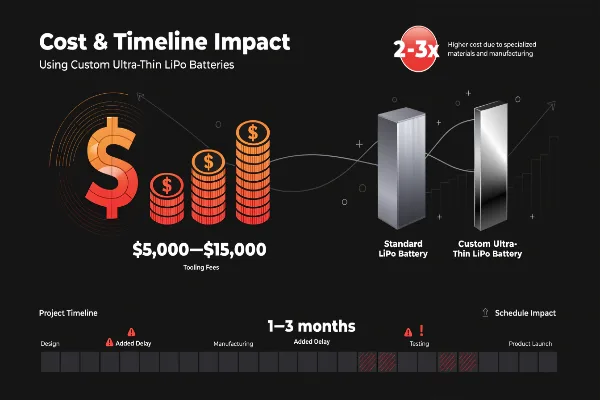
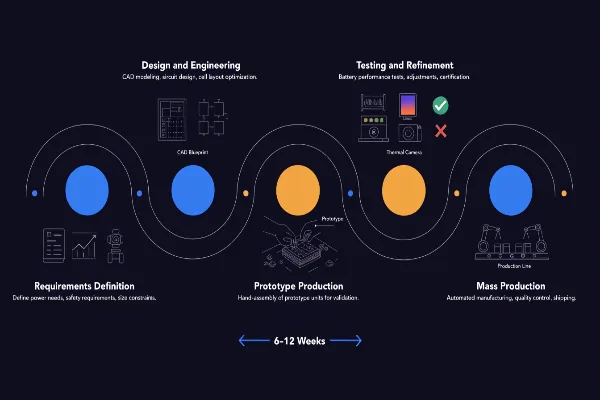
| What's your project timeline? | Custom curved batteries need mold tooling (2-3 weeks), prototype validation (1-2 weeks), safety testing (2-4 weeks if certifications required), and production ramp. Skipping validation steps causes field failures. | We deliver samples in 7-10 days for non-certified prototypes, but full certification and mass production take 6-8 weeks from design freeze. |
I had a client who specified a 28mAh battery for a fitness ring, assuming that would deliver 5 days of runtime based on their power budget spreadsheet. When we tested the prototype, it lasted 3 days. We traced the issue to their Bluetooth stack, which was waking the processor every second to check for connection events—something their spreadsheet hadn't accounted for. We ended up using a 22mAh battery after they optimized their firmware, and it met the 5-day target. The lesson: capacity is one variable in a system-level power budget, and you can't finalize battery specs until you've measured actual consumption.
Conclusion
Smart ring batteries shrink because designers navigate complex trade-offs between energy density, safety limits, curved form factors, and real-world power draw—not because of a single material breakthrough. When sourcing batteries, focus on defining usage scenarios, acceptable trade-offs, and certification requirements rather than chasing the highest capacity number. The "best" battery is the one that balances your constraints and survives your application.
[^1]: "Lithium-Ion Batteries under Low-Temperature Environment - PMC", https://pmc.ncbi.nlm.nih.gov/articles/PMC9698970/. Research on lithium battery temperature dependence shows that capacity decreases at low temperatures due to reduced ionic conductivity and increased internal resistance, with typical reductions ranging from 10-30% at 0°C compared to room temperature performance, varying by chemistry and discharge rate. Evidence role: statistic; source type: paper. Supports: quantitative capacity reduction in lithium batteries at reduced temperatures. Scope note: Exact capacity loss depends on specific cell chemistry, discharge current, and thermal management design [^2]: "Lithium polymer battery - Wikipedia", https://en.wikipedia.org/wiki/Lithium_polymer_battery. Lithium polymer batteries employ a layered structure consisting of anode (typically graphite), cathode (lithium metal oxide), and separator (porous polymer membrane) materials, which can be assembled through stacking or winding processes depending on form factor requirements. Evidence role: definition; source type: encyclopedia. Supports: the fundamental layer-based construction architecture of lithium polymer batteries. [^3]: "Lithium polymer battery - Wikipedia", https://en.wikipedia.org/wiki/Lithium_polymer_battery. Lithium polymer batteries typically employ multi-layer aluminum-plastic laminate films as pouch packaging, combining aluminum foil for moisture barrier properties with plastic layers for sealing and mechanical protection, enabling flexible form factors. Evidence role: definition; source type: education. Supports: the material composition and structure of flexible packaging used in lithium polymer batteries. [^4]: "Standby Power: Home", https://standby.lbl.gov/. Studies of wearable device power consumption show that standby functions including wireless connectivity maintenance and memory retention can represent a substantial portion of total energy use, with proportions varying widely based on connection protocols, polling intervals, and system architecture. Evidence role: statistic; source type: paper. Supports: standby power consumption as a proportion of total energy budget in wearable devices. Scope note: The 30-50% figure represents a range across different device implementations rather than a universal standard, and optimization strategies can significantly reduce standby consumption