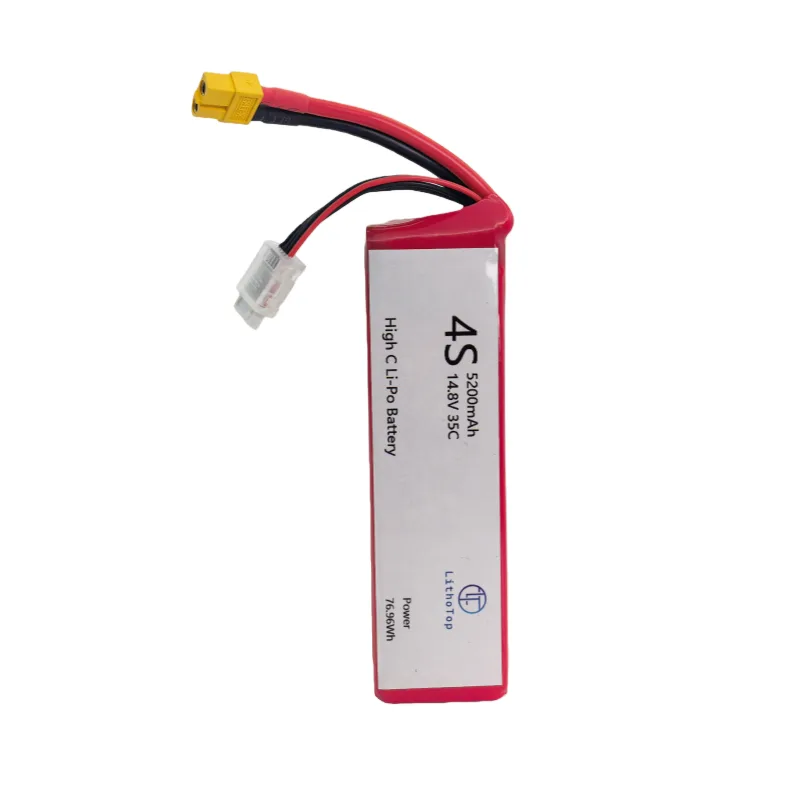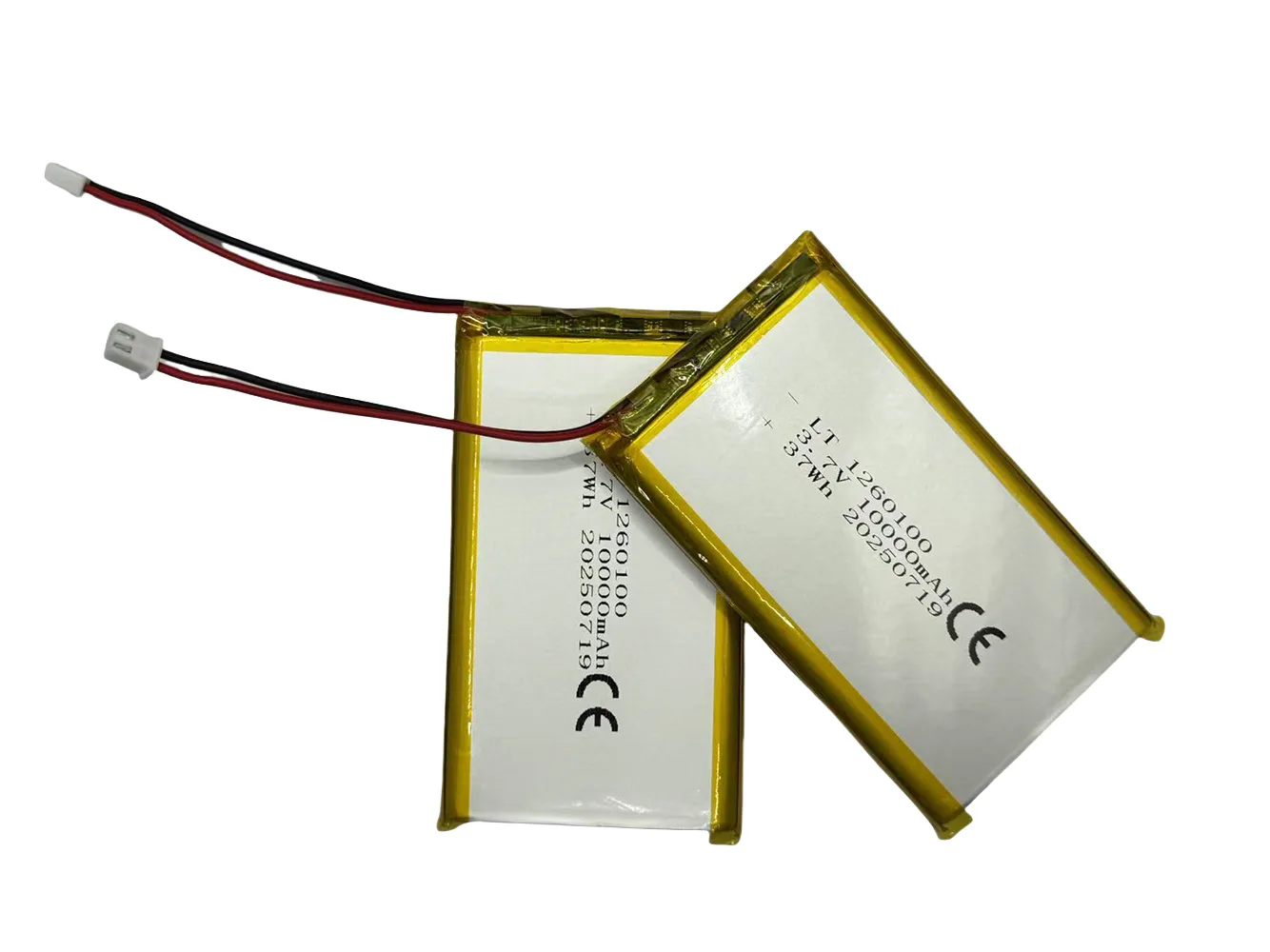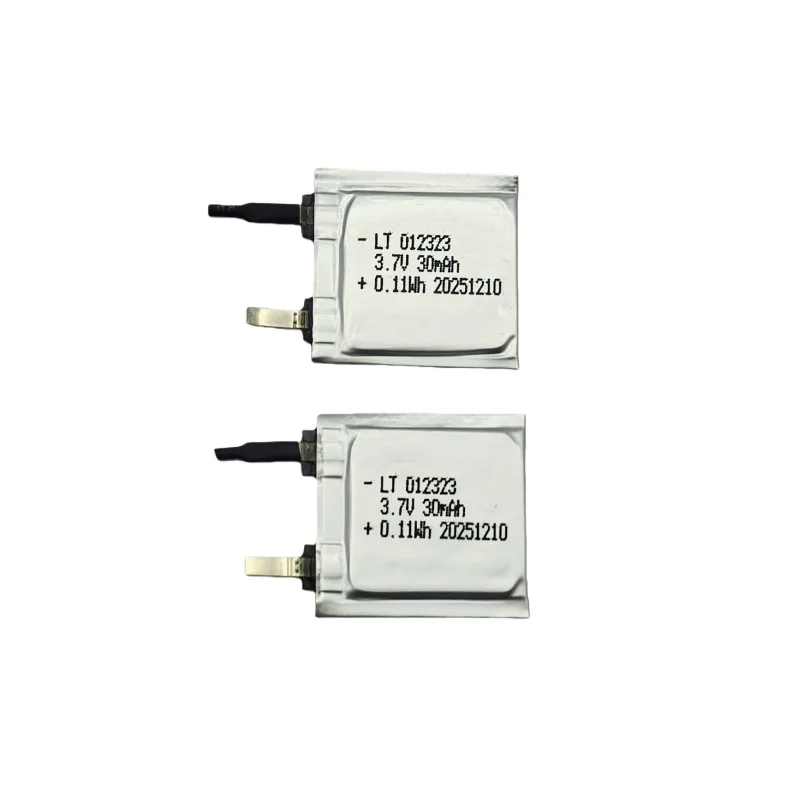
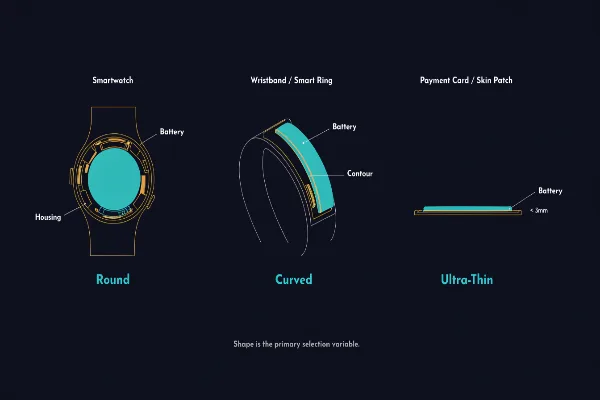
You're selecting a LiPo battery for your device, and you see three terms—Round, Curved, Ultra-Thin. You wonder: which type performs better? The real question is not about performance. It's about geometry. Your device shape determines which form you need.
Round batteries fit circular housings like smartwatches. Curved batteries follow wearable arcs in bands and rings. Ultra-Thin batteries occupy sub-3mm spaces in cards and patches. They are not different chemistries—they are form-factor solutions. Shape is the primary selection variable.
I work directly with procurement officers and product designers at LithoTop. Most buyers ask me the same question during project kickoff: "Which type should I use?" I walk them through device geometry first, not battery specs. Once we confirm the enclosure constraints, the form factor becomes clear. Let me show you how we approach this selection process.
What Is a Round LiPo Battery and When Do You Need It?
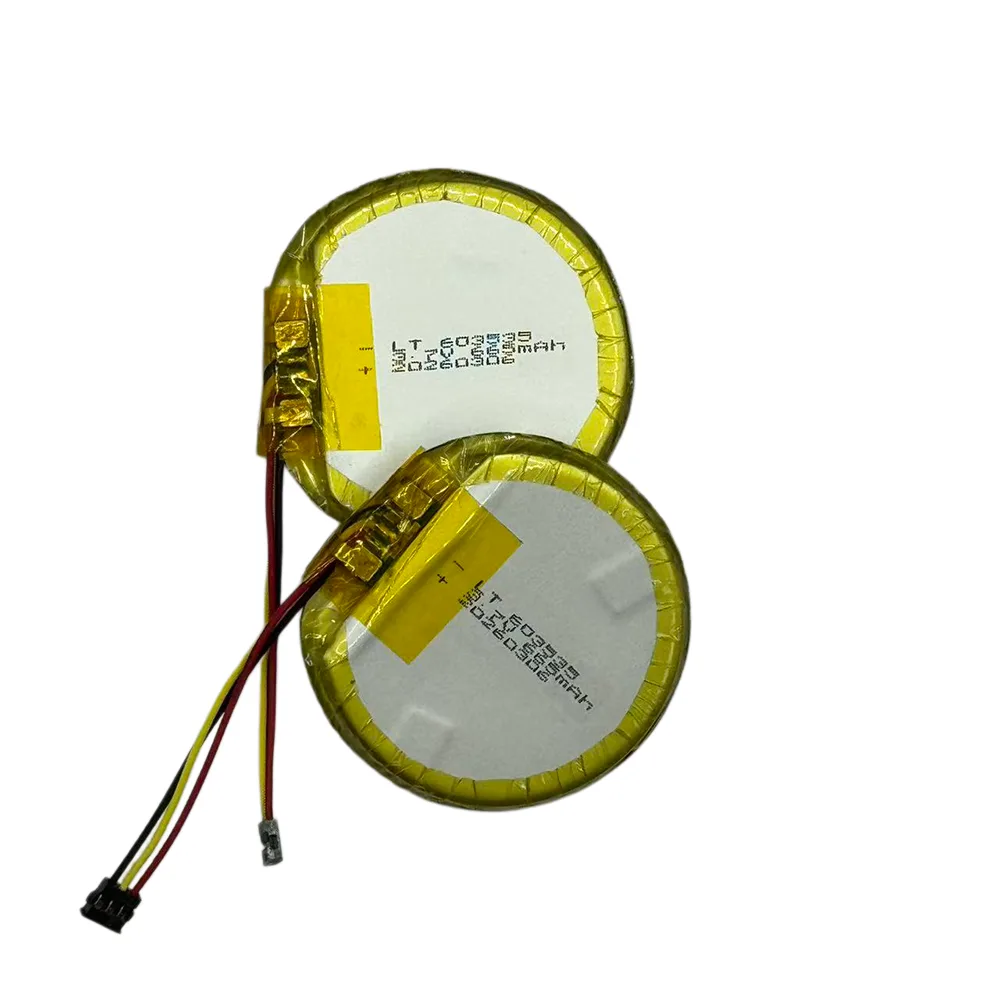
You have a circular housing. A rectangular battery wastes space. You need a round LiPo battery. This is the most common scenario I see in smartwatch projects.
Round LiPo batteries are circular polymer cells designed to maximize capacity in cylindrical or circular enclosures.^1 They fit devices where the housing is round, not rectangular. Typical applications include smartwatches, circular IoT sensors, and wearable trackers^2.
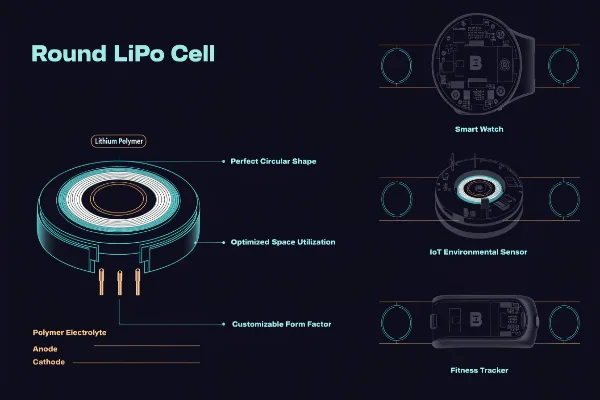
A buyer contacted us last month for a fitness tracker project. The device had a 35mm diameter housing with 5mm depth. A rectangular cell would leave corners unused. We recommended our 603535 model—60mm diameter, 3.5mm thickness. The round shape filled the entire circular space. The device gained 20% more capacity compared to a rectangular cell in the same housing.
Round batteries require only two dimensions: diameter and thickness. You confirm the housing diameter first. Then you check the available depth. We produce common sizes like 503535, 553535, 603535, and 604543. The naming follows this pattern: first two digits are diameter in mm, last four digits are thickness in mm (with decimal). For example, 603535 means 60mm diameter, 3.5mm thickness.
Standard round sizes exist because smartwatch housings follow industry norms. If your housing matches a standard size, delivery is faster. If you need a custom diameter—say, 58mm instead of 60mm—we design and fabricate it, but lead time extends by 1–2 weeks.
I often hear: "Can I use a rectangular battery instead?" Yes, you can. But you lose capacity. The corners of a rectangular cell don't touch the circular housing wall. That's wasted volume. Round cells eliminate this waste. If your device is circular, round batteries are the most efficient choice.
What Is a Curved LiPo Battery and Where Is It Used?
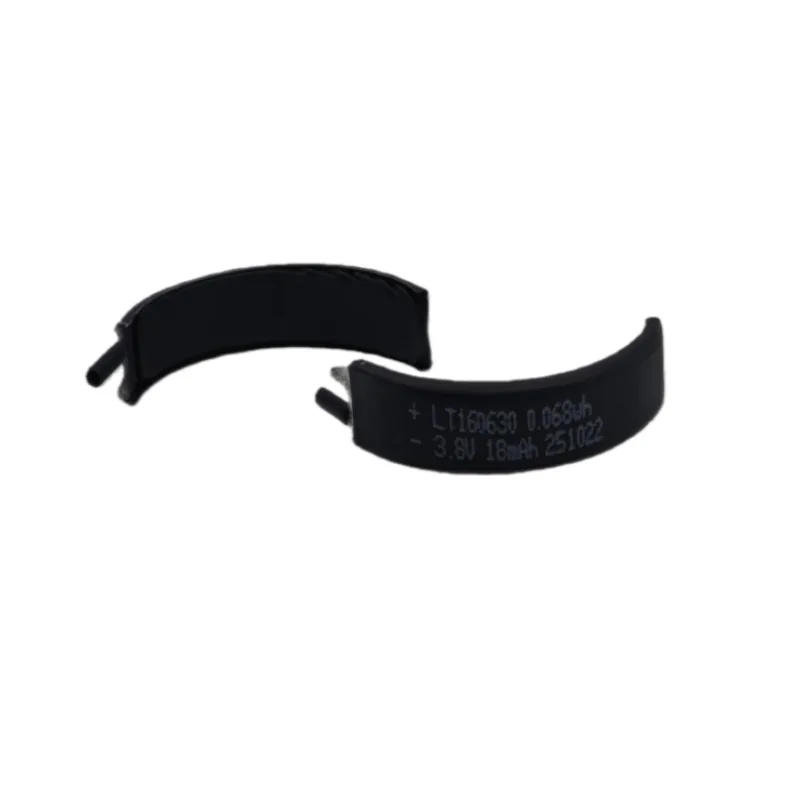
Your device has an arc. A flat battery doesn't conform. You need a curved LiPo battery. This form factor is common in wearable bands and smart rings.
Curved LiPo batteries are flexible polymer cells bent to a specific radius.^3 They follow the contour of wearable devices like smart bands, fitness trackers, and smart rings. The curvature allows the battery to fit arced housings without creating pressure points or wasting space.
Curved batteries are often called "ring batteries" when used in smart rings. The term describes the application, not a separate technology. I worked on a smart ring project last quarter. The device had an inner diameter of 18mm and an arc length of 50mm. A flat battery would either not fit or create gaps. We fabricated a curved cell with a matching radius. The battery conformed perfectly to the ring's inner curve.
Curved batteries require three specifications: arc radius, arc length, and thickness. You measure the device's inner curve radius first. Then you confirm how much of the arc the battery will occupy. Finally, you check the available thickness in the housing. We use these three dimensions to design the curvature.
Unlike round batteries, curved batteries are almost always custom. Each wearable has a unique arc radius. A fitness band with a 40mm wrist radius needs a different curve than a smart ring with an 18mm finger radius. Standard curved sizes don't exist. Customization is the norm.
I receive questions about flexibility. Buyers ask: "Can the battery bend further after installation?" No. The curvature is fixed during fabrication. We shape the cell to match your device's arc. The battery does not flex during use. If your device has multiple arc sections, we design the battery to follow the primary curve.
Curved batteries also appear in smart glasses and AR headsets. These devices have temple arms with gentle curves. A flat battery in a curved temple creates pressure on the housing. A curved battery distributes stress evenly. I handled a smart glasses project where the temple curve had a 200mm radius. We fabricated a gently curved cell that followed the temple's arc without adding bulk.
Smart rings are a growing application.^4 The battery wraps around the inner circumference of the ring. Some designs use a single curved cell covering 180 degrees. Others use two curved cells on opposite sides. The choice depends on the ring's electronics layout and required capacity.
Curved Battery Capacity and Volume
Capacity depends on total volume, not curvature. A curved battery with the same volume as a flat battery has the same capacity. The shape changes, the energy density does not.
I compare it to bending a sheet of paper. The paper's surface area doesn't change when you curve it. Similarly, a curved LiPo's active material volume remains constant. If you need 200mAh in a curved form, I calculate the required volume first. Then I design the curve to fit your device while maintaining that volume.
Buyers sometimes assume curved batteries have lower capacity than flat ones. This is incorrect. Capacity equals volume multiplied by energy density. If the volume is the same, capacity is the same. Curvature affects form, not energy storage.
What Is an Ultra-Thin LiPo Battery and Why Choose It?
Your device has less than 3mm thickness. A standard battery is too thick. You need an ultra-thin LiPo battery. This form factor is critical for cards, patches, and ultra-slim wearables.
Ultra-thin LiPo batteries are polymer cells with thickness below 3mm^5, designed for space-constrained devices. They fit applications where enclosure depth is the primary limitation, such as smart cards, medical patches, tracking tags, and slim wearables.
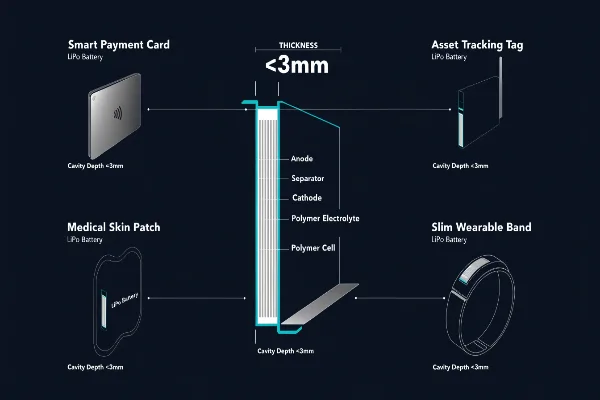
A medical device client approached us for a glucose monitor patch. The patch needed to sit flush against skin. Total thickness budget was 2.5mm, including electronics and housing. We fabricated a 1.8mm ultra-thin cell. The device maintained its low profile without compromising wearability.
Ultra-thin batteries require careful dimensional planning. Thickness is fixed by the device constraint. To achieve the required capacity, I adjust length and width. A 2mm thick battery with 50mm × 30mm dimensions has more capacity than a 2mm thick battery with 40mm × 20mm dimensions. Volume is the product of all three dimensions.
I often hear: "Ultra-thin means low capacity." This is a misunderstanding. Capacity depends on total volume. An ultra-thin battery with a large footprint can have high capacity. For example, a 2mm × 60mm × 40mm cell has 4,800 mm³ volume. A 5mm × 30mm × 20mm cell has 3,000 mm³ volume. The thinner cell has more capacity because its footprint is larger.
Ultra-thin batteries are common in smart cards and access control devices. These devices have rigid thickness limits—often under 2mm for the battery alone. I worked on an access card project with a 1.5mm thickness constraint. We designed a 1.2mm cell with extended length and width to meet the 100mAh capacity requirement. The card maintained ISO 7810 standard thickness.
Tracking tags and asset monitors also use ultra-thin batteries. These devices need to attach to flat surfaces without adding bulk. A 2mm battery allows the tag to remain nearly invisible. I handled a logistics tag project where the client needed a 2.5mm total device thickness. We provided a 1.8mm battery, leaving room for the PCB and housing.
Ultra-Thin Battery Customization
Ultra-thin batteries are almost always custom. Thickness alone doesn't define the battery—you also need specific length and width to fit your device layout. I ask for your device's dimensional drawing first. Then I calculate the maximum battery footprint within your available space. Finally, I determine if the resulting volume meets your capacity requirement.
Some buyers request ultra-thin batteries without checking volume math. They specify 1.5mm thickness and 500mAh capacity but provide only 30mm × 20mm footprint. The volume is insufficient. I calculate: 1.5mm × 30mm × 20mm = 900 mm³. With standard LiPo energy density, this volume yields approximately 50–60mAh, not 500mAh. I explain the volume constraint and suggest either increasing thickness, expanding footprint, or reducing capacity expectations.
Ultra-thin batteries require precise fabrication. A 0.2mm thickness variation is significant at this scale. We control thickness tolerance to ±0.1mm during production. This precision ensures the battery fits your enclosure without creating pressure or gaps.
How Do I Choose Between Round, Curved, and Ultra-Thin?
You choose based on device geometry, not battery performance. I follow a decision tree with every client: What is your housing shape? What is your tightest dimension constraint?
If your housing is circular, choose Round. If your housing has an arc, choose Curved. If your housing has extreme thinness, choose Ultra-Thin. The form factor is dictated by the space you have, not by the energy you need.
Selection Decision Tree
| Device Geometry | Tightest Constraint | Recommended Form | Example Application |
|---|---|---|---|
| Circular housing | Diameter | Round | Smartwatch, circular sensor |
| Arc or curve | Bend radius | Curved | Smart band, smart ring |
| Rectangular, very thin | Thickness (<3mm) | Ultra-Thin | Smart card, medical patch |
| Rectangular, standard | None extreme | Standard rectangular | Most consumer electronics |
I also check your capacity requirement. If the required capacity exceeds what your chosen form can provide, I suggest design adjustments. For example, a buyer wanted a 35mm diameter round battery with 500mAh. The volume was insufficient. I calculated maximum achievable capacity for that diameter and thickness. We either increased diameter or reduced capacity expectations.
Common Selection Mistakes
I see three recurring mistakes:
Choosing form based on perceived performance. Buyers assume curved batteries have better flexibility or ultra-thin batteries have advanced chemistry. They don't. All three use the same LiPo chemistry. Form is geometry, not technology.
Ignoring volume math. Buyers specify ultra-thin without checking if their footprint supports the required capacity. I always calculate volume first.
Requesting standard sizes for custom forms. Buyers ask for "standard curved battery" or "standard ultra-thin battery." These forms are inherently custom. Standard sizes exist only for common rectangular and some round cells.
I also encounter buyers who combine forms. A recent project needed a curved battery that was also ultra-thin—a smart ring with limited radial thickness. This required custom design with both curvature and thinness constraints. We fabricated it, but lead time extended because we designed the tooling from scratch.
What About Capacity Differences Between These Forms?
Capacity is not determined by form. It is determined by volume and energy density. A round battery, a curved battery, and an ultra-thin battery with the same volume have the same capacity, assuming identical chemistry and construction quality.
Energy density for LiPo batteries is typically 400–500 Wh/L across all form factors. Capacity = Volume × Energy Density. If volume is constant, capacity is constant, regardless of whether the cell is round, curved, or ultra-thin.
I explain this with an example. A 603535 round battery has approximately 3.14 × (30mm)² × 3.5mm ≈ 9,896 mm³ volume (using radius 30mm). A rectangular battery with 50mm × 35mm × 5.7mm has 9,975 mm³ volume. Both have similar capacity—around 600–700mAh—because their volumes are similar.
The same logic applies to curved batteries. Curvature doesn't change the active material volume. If you flatten a curved battery (hypothetically), its length, width, and thickness product remains the same. Capacity is unchanged.
I also clarify: energy density can vary slightly based on internal construction and electrode thickness, but this variation is independent of external form. A poorly designed rectangular battery can have lower energy density than a well-designed ultra-thin battery. Form factor does not inherently dictate energy density.
Volume Calculation for Capacity Estimation
When I estimate capacity for a custom form, I calculate volume first:
- Rectangular or Ultra-Thin: Volume = Length × Width × Thickness
- Round: Volume ≈ π × (Diameter/2)² × Thickness
- Curved: Volume ≈ Arc Length × Width × Thickness (approximation, exact calculation requires arc integral)
Then I apply energy density. For standard LiPo, I use 450 Wh/L (mid-range estimate). I convert volume from mm³ to liters, multiply by energy density, then convert Wh to mAh using nominal voltage (3.7V for LiPo).
Example: A 2mm × 50mm × 30mm ultra-thin battery has 3,000 mm³ = 0.003 L volume. At 450 Wh/L: 0.003 × 450 = 1.35 Wh. At 3.7V: 1.35 Wh / 3.7V ≈ 365 mAh. This is an estimate. Actual capacity depends on internal design and testing.
I provide this calculation to buyers during the quoting stage. It sets realistic expectations. If the calculated capacity is far below their requirement, I suggest increasing dimensions or reconsidering the device layout before we proceed to custom design.
What Is the Customization Process for Each Form?
Customization differs by form factor. Round batteries have the simplest process if your size is standard. Curved and ultra-thin batteries require full custom design.
For Round Batteries: I check our standard size list first. If your diameter and thickness match a standard model, I provide a quote immediately. If your size is non-standard, I request your exact diameter and thickness. We design the electrode winding to match. Tooling adjustment takes 1–2 weeks. Sample delivery is 15-20 days from tooling completion.
For Curved Batteries: I request three specifications—arc radius, arc length, and thickness. I also ask for a 3D model or detailed drawing of your device's curve. We use this to design the cell curvature. The electrode layers are shaped to match the arc during assembly. Tooling is fully custom. Sample delivery is 15–20 days.
For Ultra-Thin Batteries: I request length, width, and thickness. I calculate volume and confirm capacity feasibility. If volume is insufficient, I suggest dimension adjustments. We design the electrode stack to fit the ultra-thin profile. Precision control is critical. Sample delivery is 10–15 days.
Minimum Order Quantities and Lead Times
Standard round batteries have lower MOQs—often 1,000–5,000 units—because tooling is reusable. Curved and ultra-thin custom batteries have higher MOQs—typically 5,000–10,000 units—because tooling is project-specific.
I also explain lead time components:
- Design confirmation: 3–5 days for dimensional review and capacity calculation.
- Tooling fabrication: 2-4 weeks for custom forms.
- Sample production: 15-20 days.
- Sample testing and approval: 5–7 days (client-side).
- Mass production: 4-10 weeks depending on quantity.
Total time from inquiry to delivery is typically 6–12 weeks for custom forms, 4–10 weeks for standard round sizes.
I handled a project where the buyer needed curved batteries for a smart band launch. Timeline was tight—8 weeks to mass production. We expedited tooling and overlapped sample testing with tooling adjustment. We delivered on time, but it required close communication and flexibility on both sides.