You just received approval for your AGV fleet expansion, and now you face a choice: off-the-shelf battery packs that ship next week, or custom solutions that promise perfect integration in eight weeks. The decision feels simple until you realize your runtime calculations don't account for cold-storage operations, and your charging infrastructure can't support the fast-charge cycles you assumed were standard.
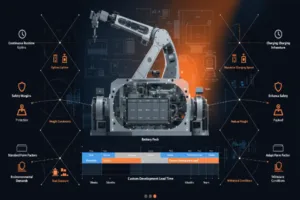
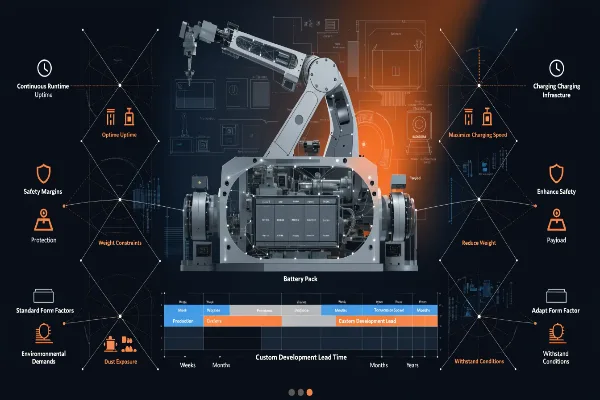
Custom battery packs for industrial automation equipment are not about matching voltage and capacity specs—they are about trading off continuous runtime against charging infrastructure, safety margins against weight constraints, and standard form factors against application-specific environmental demands. The right choice depends on whether your equipment prioritizes uptime, payload capacity, or operating condition adaptability, and whether your production schedule can absorb custom development lead times.
I work with equipment designers and procurement teams who come to us with what looks like a straightforward request: "We need a 48V 20Ah battery for our AGV." But when we ask about their charging schedule, operating temperature, and duty cycle, we often discover their assumptions don't match their constraints. A battery that works perfectly in a climate-controlled warehouse will fail in a cold-storage facility.[^1] A pack optimized for weight will not survive the vibration profile of a mobile robot. This is what we need to figure out before we talk about specifications.
How Do You Calculate Real Runtime for AGV and AMR Applications?
Your AGV manufacturer gives you a power consumption spec, you divide battery capacity by average power draw, and you get an estimated runtime. This calculation breaks the moment you introduce fast charging or temperature variation into the system.
Runtime calculations based on nameplate capacity become meaningless when your battery cannot sustain high discharge and recharge cycles for hundreds of operating days without losing significant capacity. The real question is not how long the battery runs today, but how long it runs after six months of your actual charging regime.
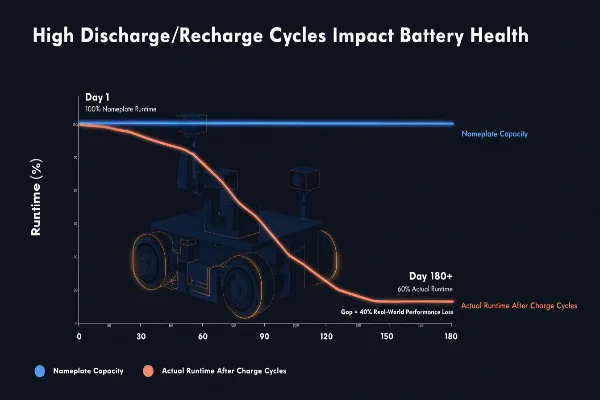
We recently worked with a logistics company deploying 50 AGVs in a fulfillment center. They calculated 8 hours of runtime based on nameplate capacity and average power consumption. Their plan was to fast-charge during shift breaks—15 minutes at 2C rate, twice per shift. The problem emerged after 120 days: their batteries were delivering only 70% of original capacity, and runtime dropped to 5.6 hours. Their vehicles were idling at charging stations during peak hours.
What Actually Affects AGV Battery Runtime?
The disconnect between calculated and actual runtime comes from three variables that datasheet specs do not capture:
| Variable | Datasheet Assumption | Actual Operating Condition | Impact on Runtime |
|---|---|---|---|
| Discharge rate | Continuous 0.5C | Intermittent 2C peaks during acceleration | 15-20% capacity reduction at high C-rates |
| Charging regime | Standard 0.5C charge | 2C fast charge twice per shift | 30% cycle life reduction after 300 cycles |
| Operating temperature | 25°C ambient | 5-35°C variation in warehouse | 10-15% capacity loss at temperature extremes |
The logistics company's issue was not battery quality—it was that their charging infrastructure created a cycle life problem. Fast charging twice per shift meant 730 fast-charge cycles per year. Their battery was rated for 500 cycles at 1C charge rate, but they were operating at 2C. The cycle life at 2C was approximately 300 cycles, which meant 40% capacity loss in under six months.
How We Approach Runtime Requirements
When someone asks us for an AGV battery, we do not start with capacity selection. We start with these questions:
- What is your actual duty cycle—continuous operation or intermittent with rest periods?
- What is your charging infrastructure—slow charge overnight or fast charge during breaks?
- What is your acceptable capacity retention at end of life—80%, 70%, or 60%?
- What is your actual operating temperature range—indoor climate control or temperature variation?
For the logistics company, the solution was not a higher-capacity battery. We recommended a dual-battery system with hot-swappable packs and slower charging infrastructure. Their AGVs now carry two 10Ah packs instead of one 20Ah pack. When one pack reaches 30% capacity, the AGV automatically switches to the second pack and returns to a charging station during low-demand periods. The swap takes 15 seconds, and both packs charge at 0.5C rate. Their capacity retention after six months is now 88%, and their vehicles maintain 7.5 hours of effective runtime.
Why Do Collaborative Robot Battery Solutions Fail Weight and Safety Requirements?
Collaborative robots operate in shared workspaces with humans, which means their battery systems must meet safety certifications that consumer or industrial batteries do not require. Adding safety features increases weight, and weight reduces payload capacity or changes the robot's certified working envelope.
A battery rated for collaborative robot use may add 200 grams of protection circuitry and mechanical reinforcement compared to an equivalent industrial pack. For a robot with a 5 kg payload rating, this 200-gram difference can reduce usable payload by 4% or require recertification of the entire robot arm. You need to know which safety features are regulatory requirements and which are vendor preferences.
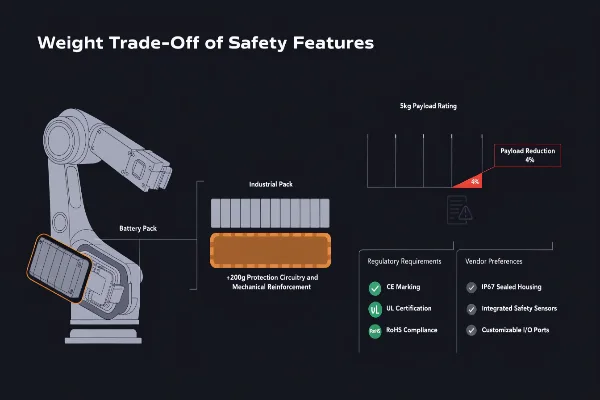
We worked with a cobot manufacturer in Germany who was designing a 7-axis robot arm for precision assembly tasks. Their payload requirement was 3 kg at full extension, and their battery weight budget was 400 grams. They initially requested a standard 14.8V 5000mAh pack, which weighed 380 grams without protection circuitry.
What Safety Features Are Non-Negotiable for Cobots?
The challenge with cobot batteries is that safety requirements vary by certification body and deployment region. A robot certified for EU markets may need different protection features than one certified for North American or Asian markets. Here is what we typically see:
| Safety Feature | Weight Impact | Regulatory Status | Consequence of Omission |
|---|---|---|---|
| Impact-resistant housing | +80-120g | Required by ISO/TS 15066 for cobots | Certification failure; cannot deploy in shared workspace |
| Dual-layer short circuit protection | +30-50g | Required by UL 2271 (North America) | Fire risk; liability exposure |
| Temperature fuse and thermal cutoff | +15-25g | Required by IEC 62133 | Thermal runaway risk in impact scenarios |
| Battery management system (BMS) with cell balancing | +45-70g | Not universally required but recommended | Reduced cycle life; voltage imbalance over time |
For the German cobot manufacturer, adding all required safety features increased battery weight to 565 grams—165 grams over budget. This extra weight reduced their payload capacity to 2.67 kg at full extension, which broke their original design specification.
How We Resolved the Weight-Safety Trade-Off
The solution was not to remove safety features—that would fail certification. Instead, we worked with the customer to redefine the battery placement and form factor. The original design placed the battery pack at the end of the robot arm to simplify cable routing. We proposed moving the battery to the base of the robot, which removed it from the moving mass calculation.
This required a custom L-shaped battery form factor to fit within the base housing, and we used high-energy-density cylindrical cells to reduce overall pack weight to 485 grams while maintaining the same capacity. The robot now meets its 3 kg payload specification, passes ISO/TS 15066 certification, and the battery is not subject to the same impact forces during operation.
The custom form factor added four weeks to the delivery schedule and required a 500-unit minimum order quantity for the custom mold. The customer accepted this because the alternative was redesigning the entire robot arm to accommodate the weight increase.
Does Your Temperature Range Specification Match Your Operating Environment?
Battery datasheets list temperature ranges that look reassuring: "-20°C to 60°C operating range" suggests the battery will work in almost any industrial environment. But this spec typically refers to storage temperature, not continuous discharge temperature, and the capacity at temperature extremes can drop by 30% or more.
A battery rated for -20°C to 60°C may only deliver 70% of its nameplate capacity at -10°C under load[^2], and it may experience accelerated degradation if continuously operated above 45°C. If your AGV operates in a cold-storage facility or your instrumentation sits in direct sunlight, you need discharge curves at your actual operating temperature, not datasheet storage ranges.
We worked with a food distribution company deploying AGVs in a -5°C cold-storage warehouse. Their battery supplier provided packs rated for -20°C operation, and initial testing in the warehouse showed acceptable performance. But after two weeks of continuous use, their AGVs were returning to charging stations with 40% capacity remaining, and operators were manually repositioning vehicles to complete tasks.
Why Temperature Ratings Are Misleading
The issue is that battery chemistry behaves differently under load than at rest. Lithium-ion cells experience increased internal resistance at low temperatures, which reduces both discharge capacity and charge acceptance.[^3] Here is what actually happens:
| Temperature | Rated Capacity (at rest) | Discharge Capacity (1C rate) | Charge Acceptance | Cycle Life Impact |
|---|---|---|---|---|
| 25°C (optimal) | 100% | 100% | 100% (1C charge) | Baseline (500 cycles to 80%) |
| 0°C | 95% | 75-80% | 50% (0.5C max charge) | 15% cycle life reduction |
| -10°C | 90% | 65-70% | 30% (0.3C max charge) | 25% cycle life reduction |
| -20°C | 85% | 50-55% | Not recommended | 40%+ cycle life reduction |
The food distribution company's AGVs were experiencing two problems: reduced discharge capacity at -5°C, and severely limited charge acceptance. Their fast-charge strategy, which worked perfectly at room temperature, was incompatible with cold-storage operations. The batteries could only accept a 0.4C charge rate at -5°C, which meant a full recharge took 2.5 hours instead of 45 minutes.
How We Handle Low-Temperature Applications
For continuous low-temperature operation, we do not simply provide a battery rated for the temperature range. We provide three options and explain the trade-offs:
Self-heating battery packs: These include internal heating elements that maintain cell temperature above 10°C during operation. This solves the capacity and charge acceptance problems but adds 150-200 grams of weight and consumes 8-12% of battery capacity for heating. Lead time is 6-8 weeks for custom integration.
Insulated battery housings with phase-change materials: These maintain temperature stability through insulation and thermal mass, which reduces heating power consumption to 3-5% of capacity. Weight penalty is 100-150 grams, and lead time is 4-6 weeks.
Standard batteries with modified charging infrastructure: This approach uses heated charging stations that warm the batteries to 15°C before charging, then charges at standard rates. No battery modification required, but charging time increases by 30-45 minutes per cycle.
The food distribution company chose option 2 for their application. The insulated housings reduced their heating power consumption, and their AGVs now maintain 85% of rated capacity at -5°C with a charge acceptance rate of 0.7C. Their total cost of ownership decreased because battery cycle life improved by 20% compared to unheated packs operating at the same temperature.
When Does Custom Form Factor Make Sense vs Standard Battery Plus Adaptation?
Custom battery form factors sound appealing: they promise perfect integration, optimized space utilization, and professional appearance. But custom development introduces lead time, minimum order quantity requirements, and validation cycles that standard batteries do not require.
The decision to customize should be based on whether standard battery sizes genuinely cannot fit within your design constraints, not on aesthetic preferences or minor space optimization. Custom form factors make sense when standard batteries create mechanical interference, thermal management problems, or certification issues—not when they simply look less elegant.
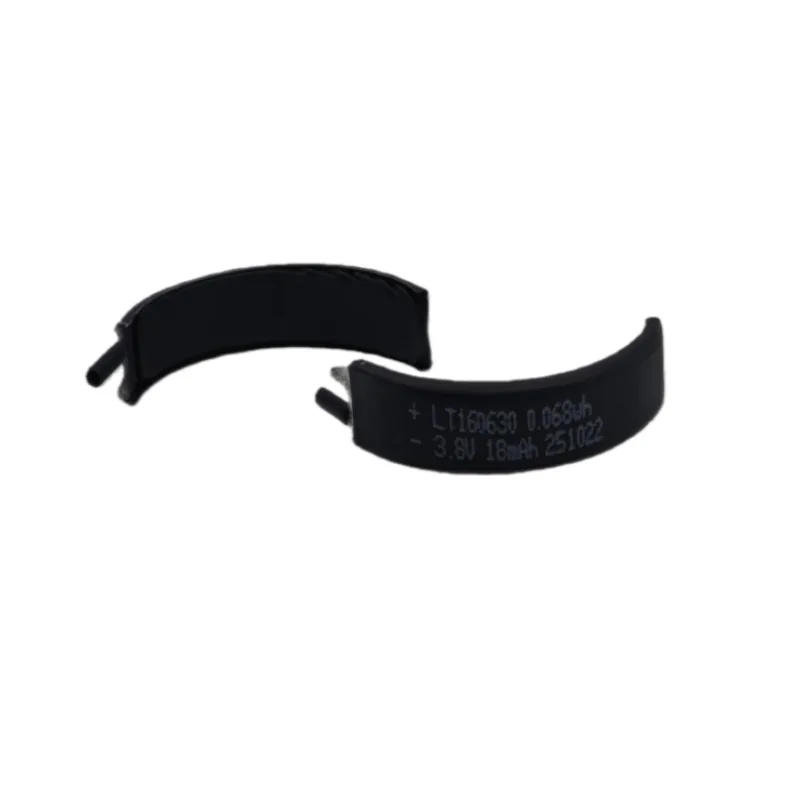
We worked with an industrial instrumentation manufacturer who requested a custom curved battery to fit inside a cylindrical housing for a handheld inspection device. Their design allocated a 35mm diameter x 120mm length battery cavity, and they wanted maximum capacity within this space. They assumed a custom cylindrical pack was the only solution.
What Are the Real Costs of Custom Form Factors?
Custom battery development involves costs that are not immediately obvious when you compare unit prices:
| Cost Category | Standard Battery | Custom Form Factor | Hidden Costs in Custom Development |
|---|---|---|---|
| Unit cost | Baseline | +15-30% | Price breaks at higher MOQ; lower volumes = higher unit cost |
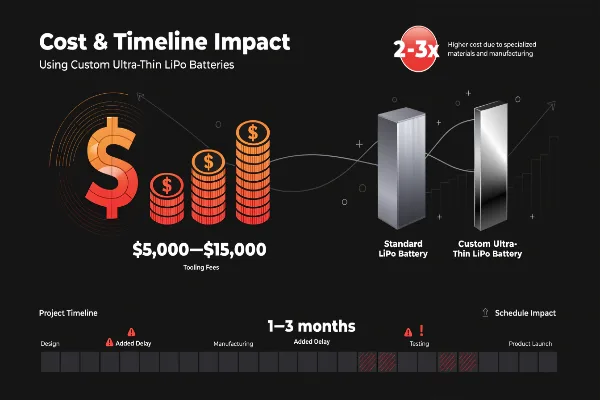
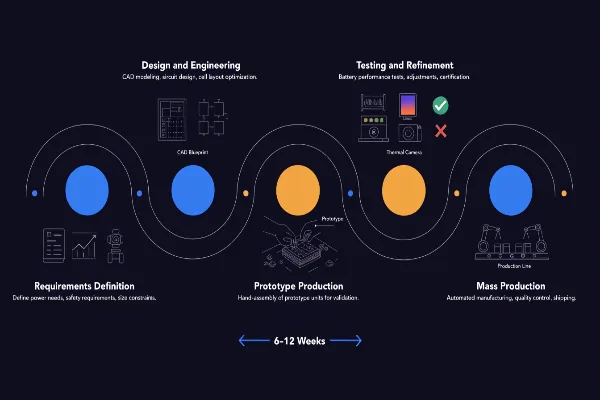
| Lead time | 1-2 weeks | 6-10 weeks | Mold development (2-3 weeks), prototype validation (2-3 weeks), production setup (2-4 weeks) |
| Minimum order quantity | 100-500 units | 1000-3000 units | Cash flow impact; inventory carrying cost |
| Revision flexibility | Order next batch with changes | Mold modification required | $2000-5000 per mold revision; 3-4 week delay |
| Second-source risk | Multiple suppliers available | Mold is supplier-specific | Switching costs if supplier relationship fails |
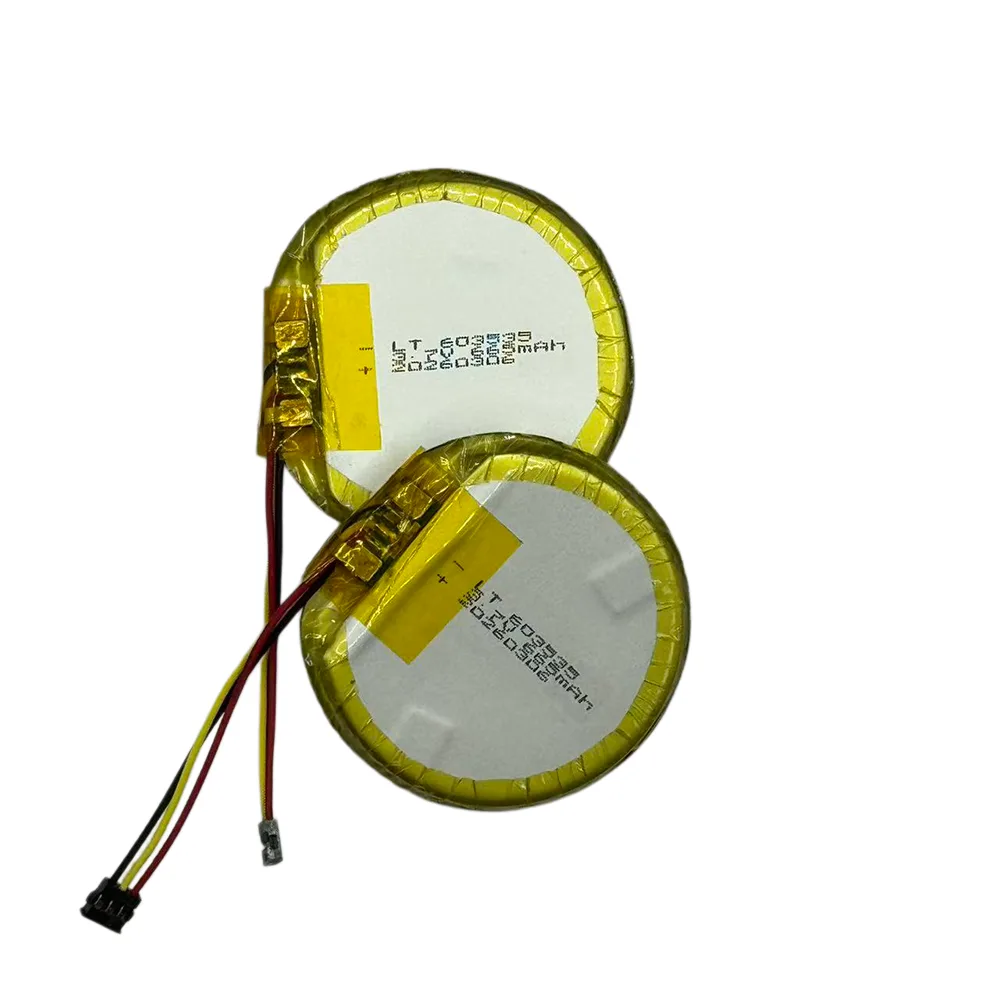
For the instrumentation manufacturer, we first explored standard battery options. We found that three 18650 cylindrical cells in a triangular configuration fit within their 35mm diameter constraint and provided 92% of the capacity they would get from a custom cylindrical pack. The standard cell approach had a 10-day lead time, 500-unit MOQ, and no mold development cost.
Our Decision Framework for Custom vs Standard
We ask customers to evaluate these questions before committing to custom development:
Can standard batteries fit with minor housing modifications? If adding 2-3mm to your device dimensions solves the fit problem, housing modification is faster and cheaper than custom batteries.
Is your production volume stable? Custom molds amortize their cost over 5000+ units. If your volume is uncertain or you anticipate design changes, standard batteries reduce risk.
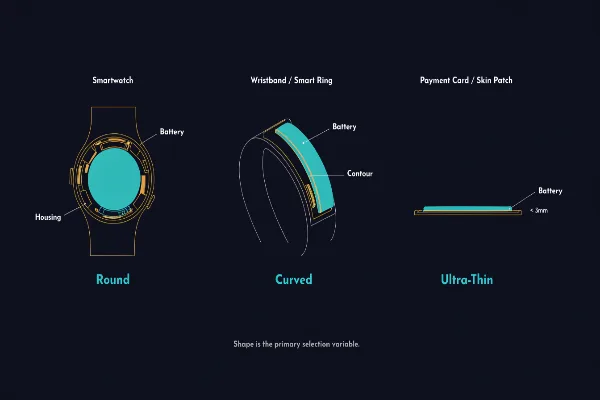
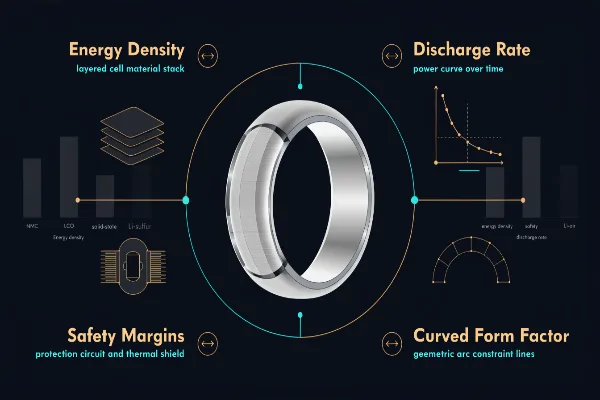
Do you have thermal or mechanical constraints that standard form factors cannot meet? Curved batteries for wearable devices or ultra-thin batteries for space-constrained designs are legitimate use cases. Cosmetic preferences are not.
What is your timeline to production? If you need to ship in 8 weeks, custom development is not feasible. Standard batteries plus adaptive mechanical design is your only option.
The instrumentation manufacturer chose the standard cell approach and modified their housing design to accommodate the triangular cell configuration. They launched production 6 weeks earlier than their original schedule, and their lower MOQ allowed them to validate market demand before committing to large inventory purchases.
Conclusion
Choosing a custom battery pack for industrial automation equipment is not about finding the highest capacity or the perfect form factor—it is about understanding which constraints matter most for your application and which assumptions about runtime, weight, temperature, or customization will break in production.
[^1]: "Lithium-Ion Batteries under Low-Temperature Environment - PMC", https://pmc.ncbi.nlm.nih.gov/articles/PMC9698970/. Research on lithium-ion battery performance demonstrates that low temperatures significantly increase internal resistance and reduce discharge capacity, with studies showing 20-40% capacity loss at temperatures below 0°C compared to room temperature operation. Evidence role: mechanism; source type: research. Supports: lithium-ion battery capacity and performance degradation at low temperatures. Scope note: The exact failure threshold depends on specific battery chemistry, discharge rate, and duration of cold exposure [^2]: "Lithium-Ion Batteries under Low-Temperature Environment - PMC", https://pmc.ncbi.nlm.nih.gov/articles/PMC9698970/. Battery testing data indicates that lithium-ion cells typically retain 60-75% of rated capacity when discharged at -10°C under moderate to high load conditions, with performance varying by chemistry, with lithium iron phosphate cells generally showing greater cold-temperature capacity loss than nickel-based chemistries. Evidence role: statistic; source type: research. Supports: capacity retention at -10°C under load. Scope note: Actual capacity retention depends on discharge rate, cell design, and thermal management [^3]: "Lithium-Ion Batteries under Low-Temperature Environment - PMC", https://pmc.ncbi.nlm.nih.gov/articles/PMC9698970/. Electrochemical studies demonstrate that lithium-ion battery internal resistance increases exponentially at temperatures below 10°C due to reduced ionic conductivity in the electrolyte and slower charge-transfer kinetics at electrode interfaces, resulting in reduced usable capacity and limited charge acceptance rates. Evidence role: mechanism; source type: paper. Supports: temperature-dependent internal resistance and its effects on battery performance.