Many brands treat battery safety late. That delay creates design stress. I see it turn small cell choices into brand trust risks.
Battery safety impacts consumer electronics brands by shaping user trust, product reliability, design freedom, production stability, and after-sales risk. I believe brands should review battery safety from early product development, not after the device structure, charging plan, and supplier choice are already fixed.
I write this from my daily work with wearable, health monitoring, and IoT hardware teams. I often see smart product ideas move fast, while battery decisions stay narrow. I understand this pressure. A brand wants a thin product, a good runtime, a fair cost, and a clear launch date. The problem is simple. The battery is not only a part inside the product. It is a small energy system inside the user’s daily life[^1]. That system must match the cell, protection board, structure, charger, software logic, and real use case. When I help clients review custom lithium battery solutions, I try to bring this discussion forward, because late safety changes often cost more than early safety planning. More information about our work is available at LithoTop.
Why Should Battery Safety Start Before Industrial Design Is Frozen?
Many projects lock the shell first. Then the battery must fit the leftover space. I see this create pressure, heat risk, and weak protection choices.
Battery safety should start before industrial design is frozen because the battery shape, cell type, protection design, charging path, heat space, and mechanical protection all affect the final product risk. Early review helps brands avoid redesign, delayed launch, and weak user trust.
The Real Question Is Not Only Capacity
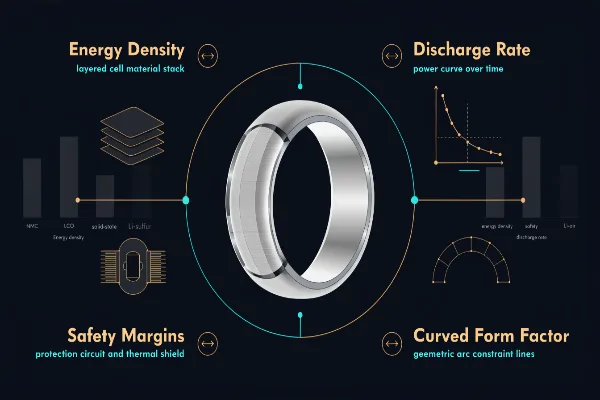
In customer discussions, I often see brands focus first on capacity, size, and price. I understand why. Capacity affects runtime. Size affects the product shape. Price affects margin. But I also ask another question. I ask whether the cell, protection board, structure, and use scenario can work together safely. This question is more useful for brand risk.
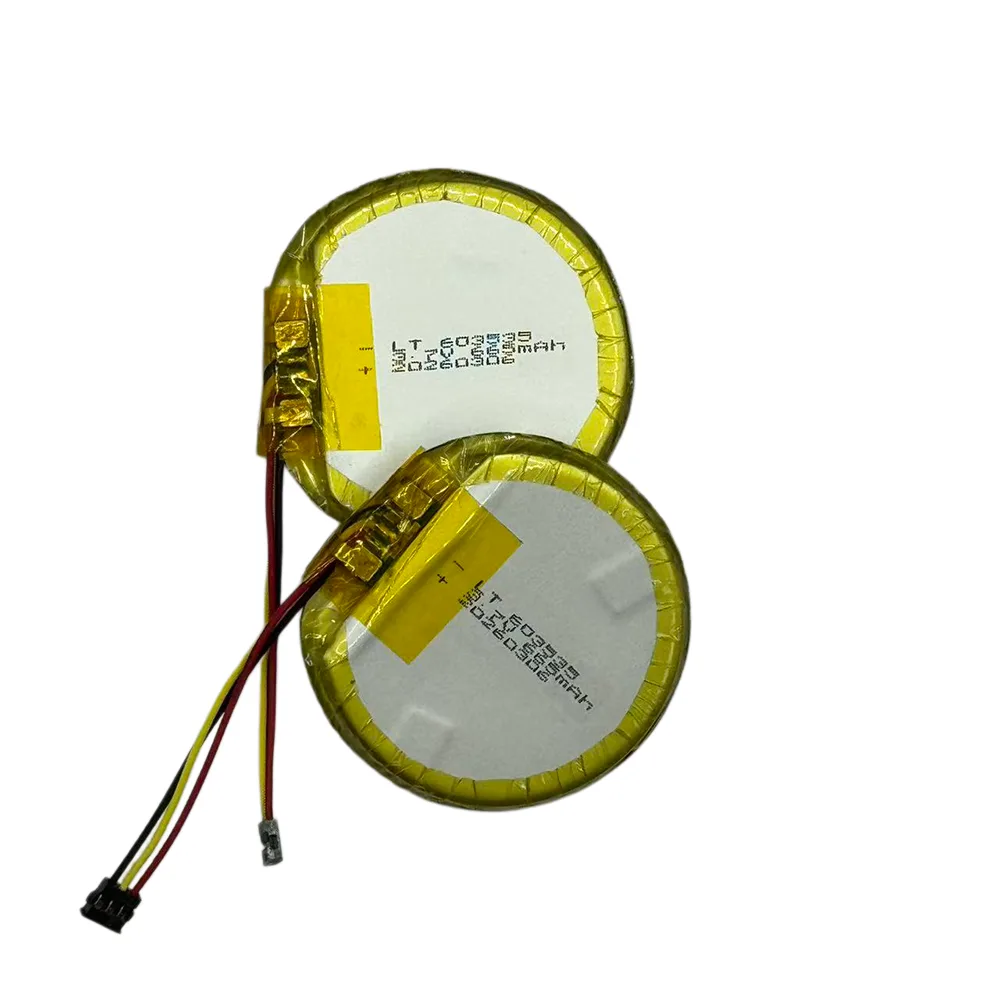
A battery inside a consumer electronic product does not live alone. It sits near a PCB, a speaker, a sensor, a motor, a heating part, or a metal shell. It may face pressure during assembly. It may sit close to skin. It may be charged by users who do not read manuals. So I see battery safety as a design issue, not only a component issue.
| Early Design Choice | Safety Meaning | Brand Risk If Ignored |
|---|---|---|
| Battery shape | It affects cell stress and assembly pressure | The product may need redesign |
| Battery capacity | It affects energy density and heat behavior | The runtime target may push unsafe trade-offs |
| Protection board position | It affects electrical protection and structure | The BMS may not protect well in real use |
| Charging current | It affects heat and battery life[^2] | Users may see swelling, shutdown, or unstable charging |
| Shell space | It affects expansion room and heat flow | The device may feel hot or fail early |
I Prefer Early Battery Review
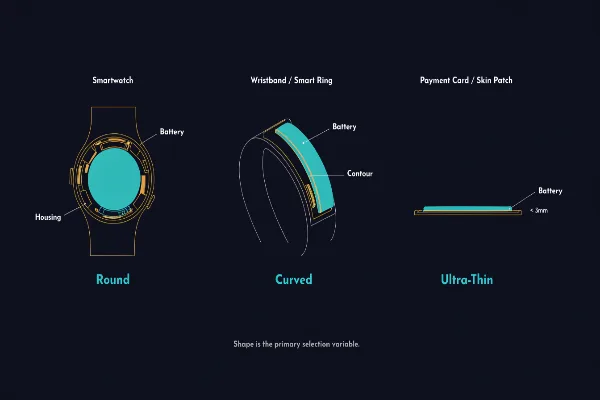
I prefer early review because it gives the brand more choices. A brand can still adjust the battery cavity. A brand can still choose a safer charging current. A brand can still leave space for a protection board. A brand can still decide whether a curved, ultra-thin, or custom-shaped battery is needed.
When the shell is already fixed, the battery supplier must solve a harder problem. The brand may ask for high capacity in a thin space. The protection circuit may have limited room. The assembly team may press the pack into the case. The charging contact may sit too close to metal parts. These details may look small, but they can become production and after-sales issues.
For consumer electronics brands, early safety planning is not slow work. It is launch protection. It protects the design, the schedule, and the product promise.
Why Is Close-To-Body Product Risk Different?
Wearable and health products feel personal. I see users trust them near skin, during sleep, or during daily movement. Battery risk becomes brand trust risk.
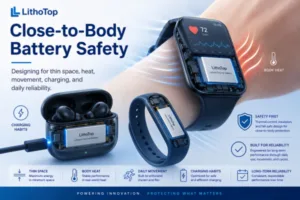
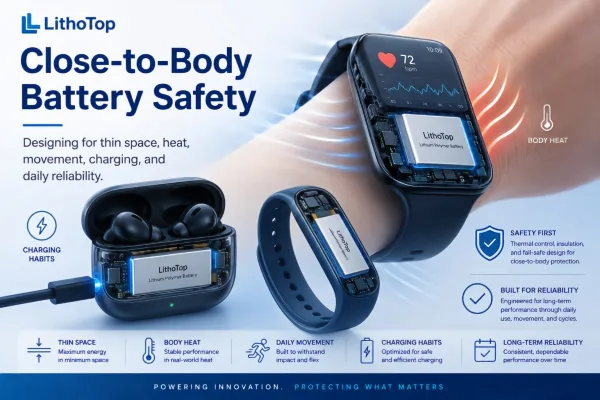
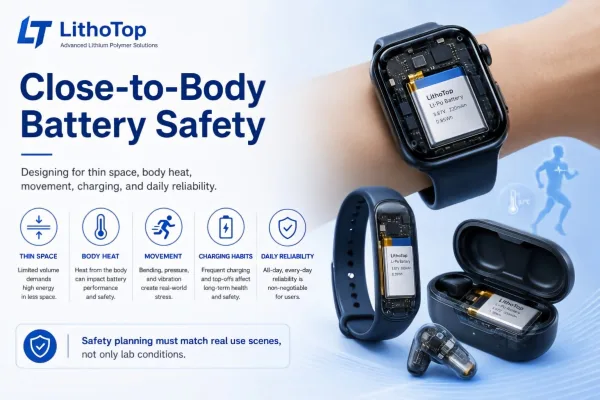
Close-to-body product risk is different because users wear or touch the device for long periods. The battery must handle thin space, body heat, movement, charging habits, and daily reliability. Safety planning must match the real use scene, not only lab conditions.
The Use Scene Changes The Safety Standard
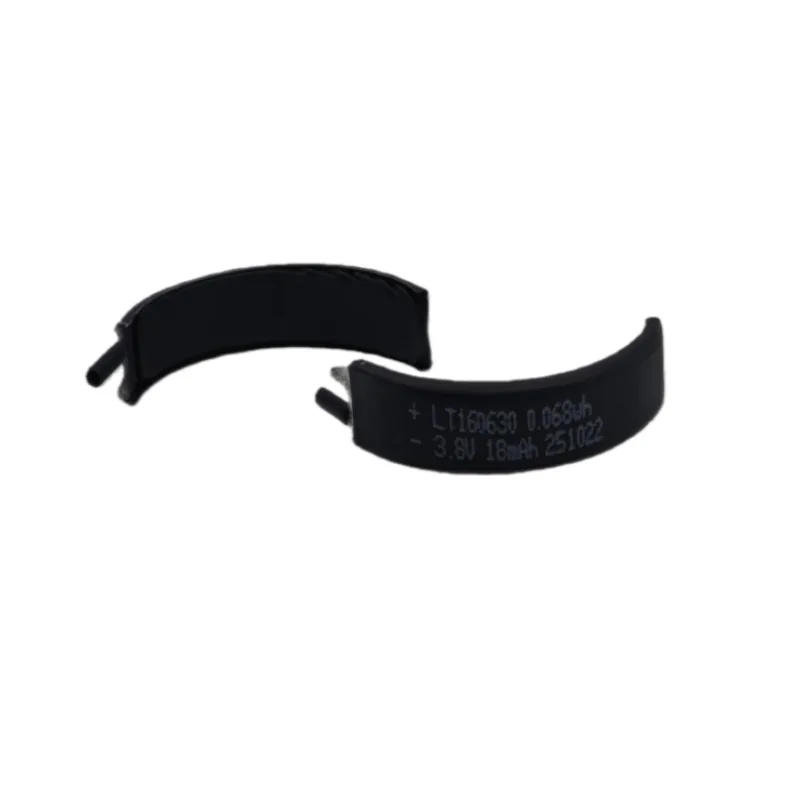
In thin and close-to-body device projects, the trade-off is often between space, energy density, protection design, and long-term reliability. I see this most often in smart watches, health patches, hearing-related products, small medical monitoring devices, and compact IoT trackers.
A user may wear a device for many hours. A user may charge it beside a bed. A user may exercise with it. A user may forget it in a hot car. A user may use a third-party charger. A user may drop it many times. These actions are normal. So I believe the battery plan must include normal user behavior, not only ideal behavior.
| Product Type | Common Use Condition | Battery Safety Focus |
|---|---|---|
| Wearable device | It touches skin and moves with the body | Thin structure, heat control, and swelling space |
| Health monitor | It may run for long periods | Stable discharge and conservative protection |
| IoT tracker | It may stay active without user attention | Low standby risk and batch consistency |
| Personal care device | It may face humidity and vibration | Sealing, insulation, and charging safety |
| Small medical device | It may need stable data and power | Reliability, traceability, and test discipline |
The User Does Not Separate Battery From Brand
A consumer does not say, “The cell design was not matched with the protection board.” A consumer says, “This brand is unsafe,” or “This product is not reliable.” That is why I connect battery safety with brand trust. The user’s view is simple. If the product heats too much, shuts down, swells, or charges strangely, the brand carries the concern.
I do not believe every safety discussion should sound dramatic. Most battery projects are managed through careful design, testing, and production control. But I also do not think brands should treat batteries as common parts that can be swapped at the end. A small product can create a large trust problem if the battery behavior does not match user expectations.
I Watch Three Practical Points
I usually watch three points in close-to-body products. First, I look at heat. The device should not make the user feel worried during use or charging. Second, I look at mechanical stress. A thin cell should not be bent, pressed, or squeezed by the housing.[^3] Third, I look at protection design. The BMS or protection board should match charging current, discharge current, cut-off voltage, and fault conditions.
These points are not only engineering details. They help the brand keep a stable user experience. They also help the product team avoid late changes after tooling, certification planning, or pilot production.
Why Can A Safe Sample Still Fail In Mass Production?
A good sample can hide weak control. I have seen brands feel confident too early, then face problems when batch production begins.
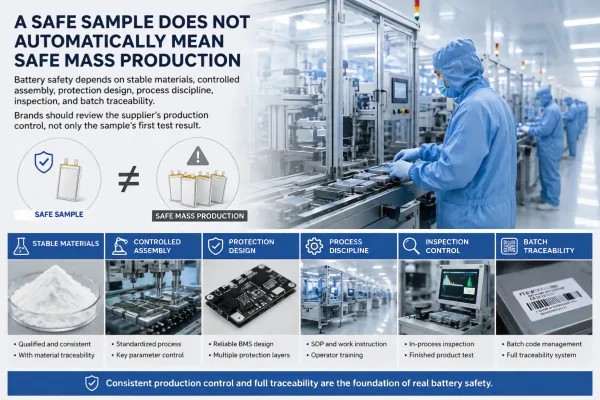
A safe sample does not automatically mean safe mass production. Battery safety depends on stable materials, controlled assembly, protection design, process discipline, inspection, and batch traceability. Brands should review the supplier’s production control, not only the sample’s first test result.
Sample Success Is Only The First Gate
A sample is important. It proves that the size, voltage, connector, capacity, and basic function can match the product. But I never treat one sample as the full safety answer. Mass production is different. It introduces material batches, worker operation, machine stability, welding control, insulation process, BMS component supply, aging test, packaging, and transport.
A sample can be made with extra care. A mass-production unit must be made with repeatable care. This difference matters for consumer electronics brands because a product launch depends on thousands or millions of stable units, not one good sample on a meeting table.
| Stage | What I Check | Why It Matters To The Brand |
|---|---|---|
| Material incoming | Cell, PCB, wire, connector, insulation material | It reduces hidden batch variation |
| Process control | Welding, assembly, sealing, and insulation | It reduces random production failures |
| Protection test | Overcharge, over-discharge, over-current logic | It supports safer real use |
| Aging and final check | Capacity, voltage, resistance, appearance | It catches unstable units before shipment |
| Traceability | Batch records and inspection records | It supports after-sales analysis |
Quality Systems Must Support Design Intent
At LithoTop, we use production and quality systems as support for battery safety work. We have ISO9001 and ISO14001 systems, 5S production management, and QC steps such as IQC, IPQC, FQC, and OQC. I mention these points for one reason. A safety design only has value when production can repeat it.
I do not see certification capability as a magic shield. CE, UN38.3, RoHS, MSDS, IEC62133, UL-related testing, and other required documents can support market access and customer confidence. But the business meaning is practical. These requirements push the project team to define the battery, test it, document it, and control it. They do not replace good design judgment.
The Brand Should Ask Better Supplier Questions
I believe brands should ask suppliers more than “Can you make this size?” or “What is the price?” A brand should ask how the supplier controls cell sourcing, BMS design, insulation, welding, aging tests, and batch records. A brand should ask how changes are managed. A brand should ask what happens if one component must be replaced. A brand should ask whether the same protection logic will stay stable in mass production.
These questions protect the brand. They also protect the supplier relationship. Clear safety requirements reduce arguments later. They help both sides define what “qualified” means before shipment.
For a consumer electronics brand, a battery failure is rarely only a factory issue. It can interrupt production. It can slow delivery. It can create after-sales cost. It can hurt product reviews. It can also make the next retailer or distributor conversation harder. So I treat mass-production safety as part of brand risk planning.
How Should Brands Turn Battery Safety Into A Product Decision?
Battery safety can feel technical. I see better results when brands turn it into clear product decisions early.
Brands should turn battery safety into product decisions by defining use scenarios, battery space, protection needs, charging rules, test standards, supplier controls, and change management before mass production. This makes safety part of design planning, not a late checklist.
I Use A Simple Decision Path
I like simple decision paths because they help business teams and engineering teams talk to each other. The brand owner may not need to know every detail of cell chemistry or BMS layout. But the brand owner should know which decisions increase or reduce risk.
| Brand Decision | Practical Question | Better Timing |
|---|---|---|
| Product use scene | Will users wear it, sleep with it, or charge it often? | Concept stage |
| Battery cavity | Is there enough space for the cell and protection board? | ID design stage |
| Runtime target | Does the runtime goal force very high energy density? | Specification stage |
| Charging plan | What charger, current, and connector will users use? | Electrical design stage |
| Supplier choice | Can the supplier control both sample and batch quality? | Before sample approval |
| Test plan | What tests match real use and market needs? | Before pilot production |
| Change control | How will material or PCB changes be approved? | Before mass production |
I do not believe one supplier alone can remove every battery safety risk. The brand, industrial designer, electronics engineer, firmware team, battery supplier, charger supplier, factory, and quality team all affect the final result. The supplier can give battery design support, BMS design, process control, and certification support. The brand still decides the product promise, launch pressure, cost limits, runtime target, and use case assumptions.
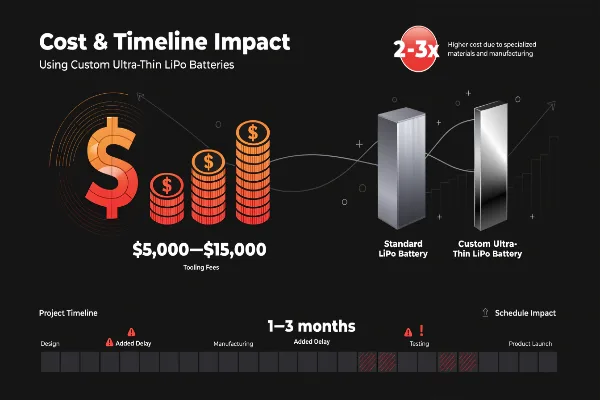
This shared view is important. If a brand asks for the thinnest product, the longest runtime, the lowest cost, and the fastest launch, the project must discuss trade-offs openly. If nobody discusses those trade-offs, the risk does not disappear. It only moves into the product.
I Prefer Direct Risk Language
I prefer direct and calm language in battery projects. I do not tell brands that every choice is dangerous. I tell brands which choices reduce margin. A very tight battery cavity reduces mechanical margin. A high charging current in a small sealed product reduces heat margin. A low-cost protection circuit may reduce fault margin. A weak supplier process reduces batch margin.
This way of speaking helps teams make better decisions. The team can choose where to spend cost. The team can choose where to keep space. The team can choose which tests are needed. The team can also decide whether the product promise must change.
For me, battery safety is not only about avoiding failure. It is about protecting the brand’s promise to the user. A safe and stable battery helps the product feel reliable every day. That feeling is part of the brand.
Conclusion
Battery safety protects more than hardware. I see it protect user trust, launch stability, supplier quality, and the long-term reputation of consumer electronics brands.
[^1]: "Guidelines on Lithium-ion Battery Use in Space Applications", https://ntrs.nasa.gov/api/citations/20090023862/downloads/20090023862.pdf. Institutional lithium-ion battery safety guidance describes rechargeable battery safety as a system issue involving the cell, charging method, protective circuitry, thermal conditions, mechanical integrity, and user handling; this supports the article’s framing of the battery as more than an isolated component. Evidence role: mechanism; source type: institution. Supports: Authoritative battery-safety guidance that treats lithium-ion batteries as systems involving cells, protective electronics, charging, thermal conditions, and operating environment.. Scope note: The source would support the systems framing, but it would not directly assess the author’s specific client projects. [^2]: "Heat Generation and Degradation Mechanism of Lithium-Ion ... - PMC", https://pmc.ncbi.nlm.nih.gov/articles/PMC9753165/. Electrochemical studies of lithium-ion cells show that charge rate influences internal heat generation, lithium plating risk, and capacity fade, supporting the article’s statement that charging current affects both thermal behavior and battery life. Evidence role: mechanism; source type: paper. Supports: Research showing that higher charge rates can increase heat generation and accelerate degradation in lithium-ion cells.. Scope note: The exact effect depends on cell chemistry, design, temperature, and the manufacturer’s specified charging limits. [^3]: "[PDF] INTERNAL SHORT CIRCUIT IN LITHIUM-ION BATTERIES", https://hammer.purdue.edu/articles/thesis/INTERNAL_SHORT_CIRCUIT_IN_LITHIUM-ION_BATTERIES/20069648/1/files/35901755.pdf. Mechanical-abuse studies of lithium-ion pouch cells show that bending, indentation, crushing, or compression can damage separators and electrodes and may initiate internal short circuits, supporting the article’s warning against housing-induced pressure on thin cells. Evidence role: mechanism; source type: paper. Supports: Research showing that mechanical deformation of lithium-ion cells can damage internal layers and increase internal short-circuit or thermal-runaway risk..