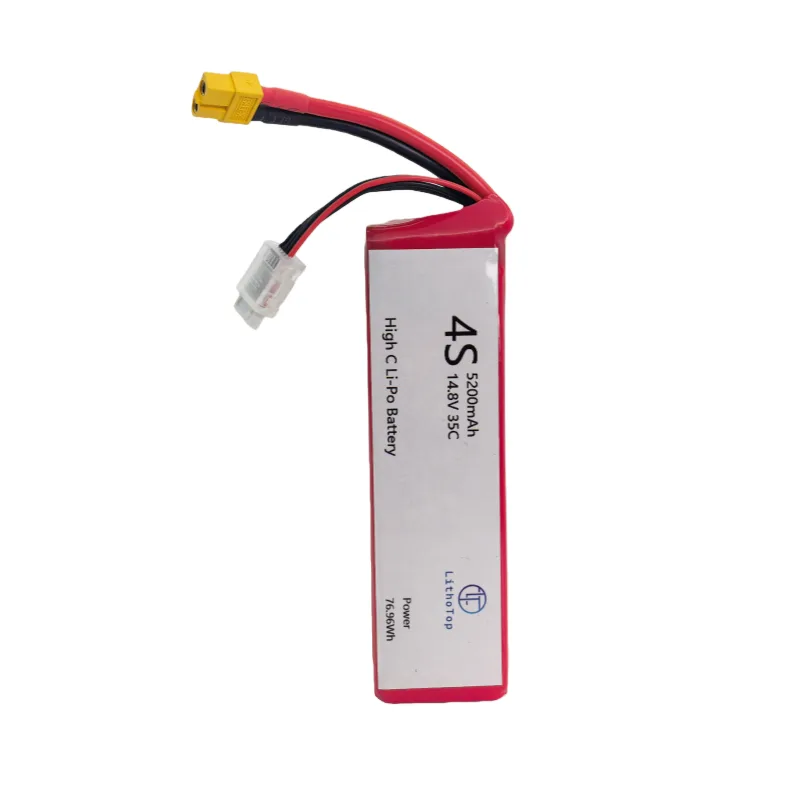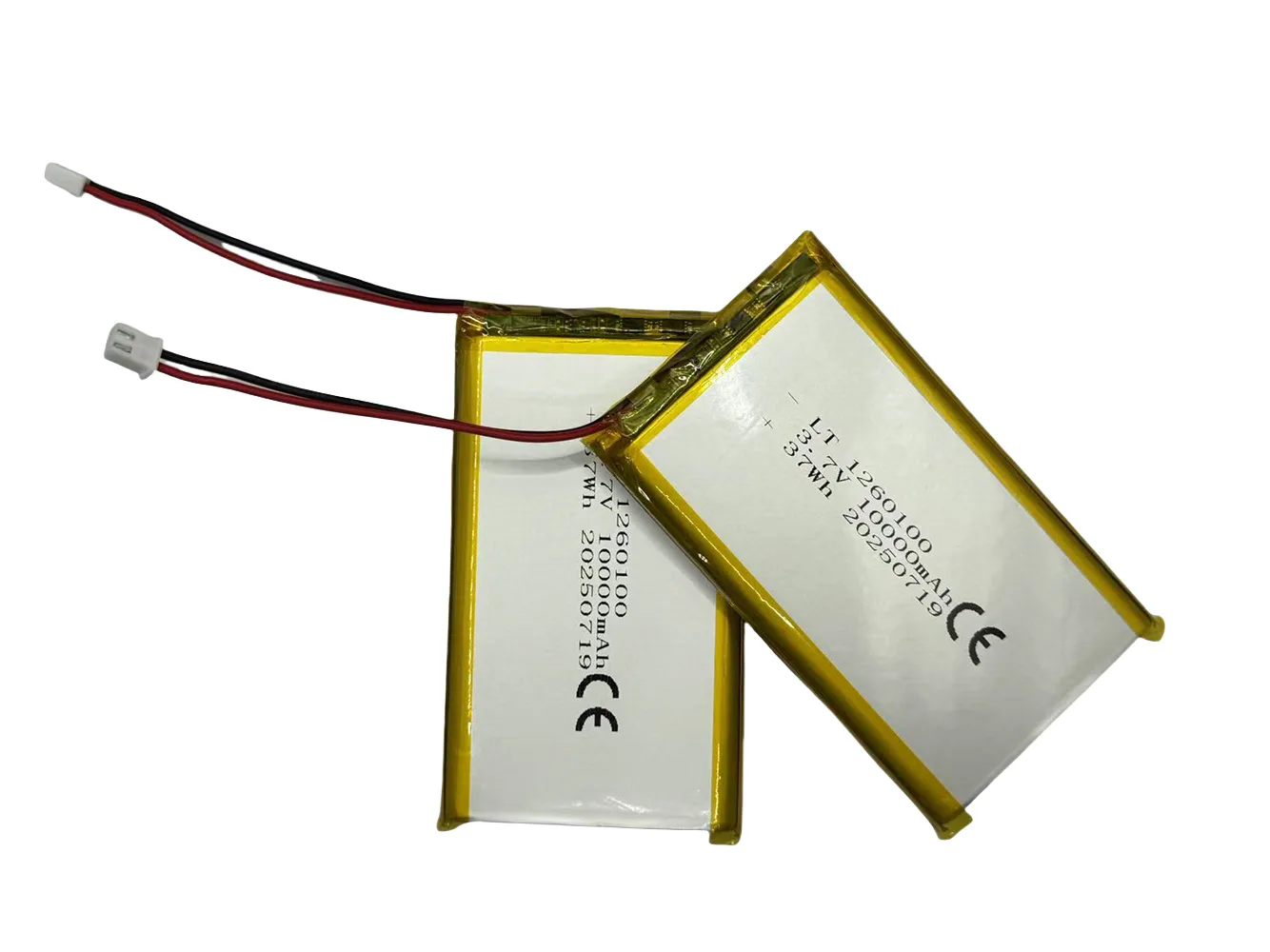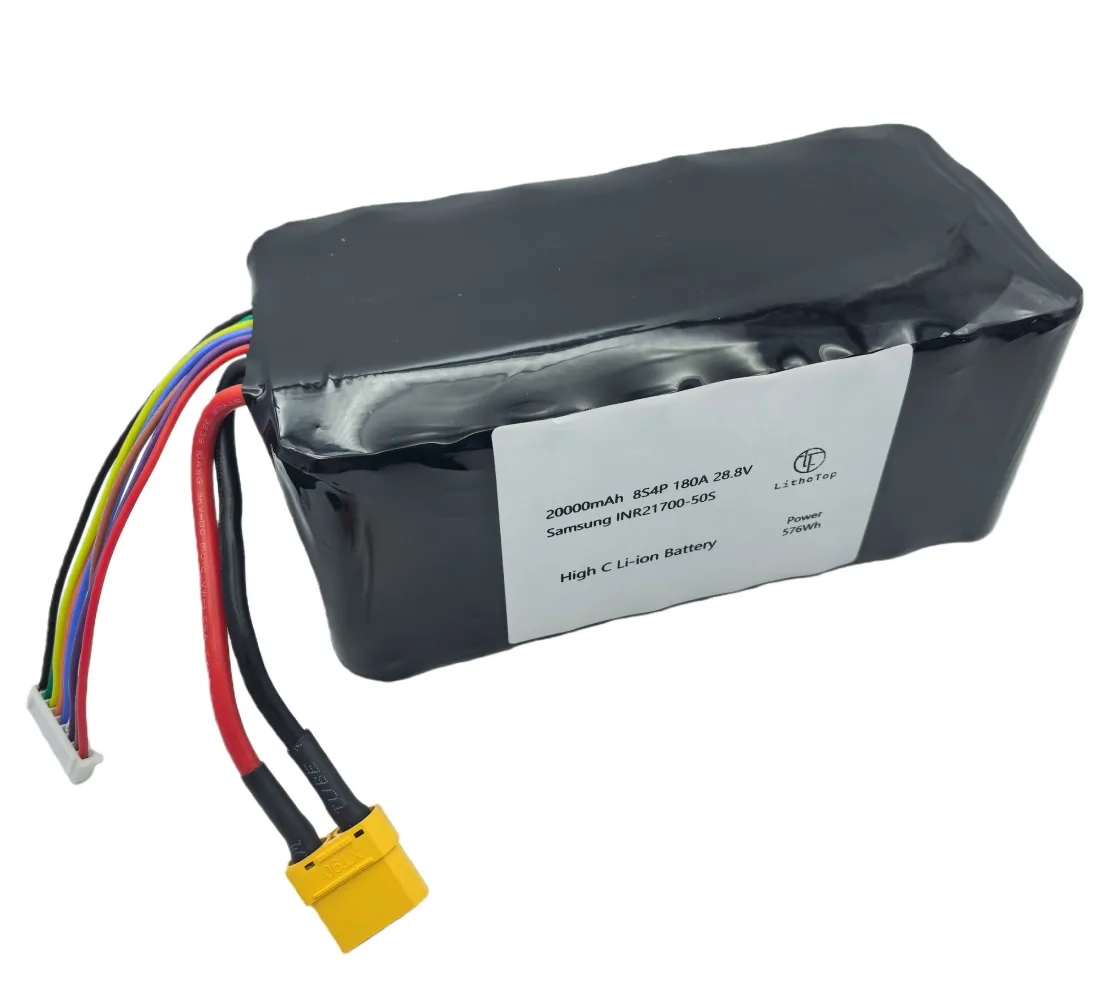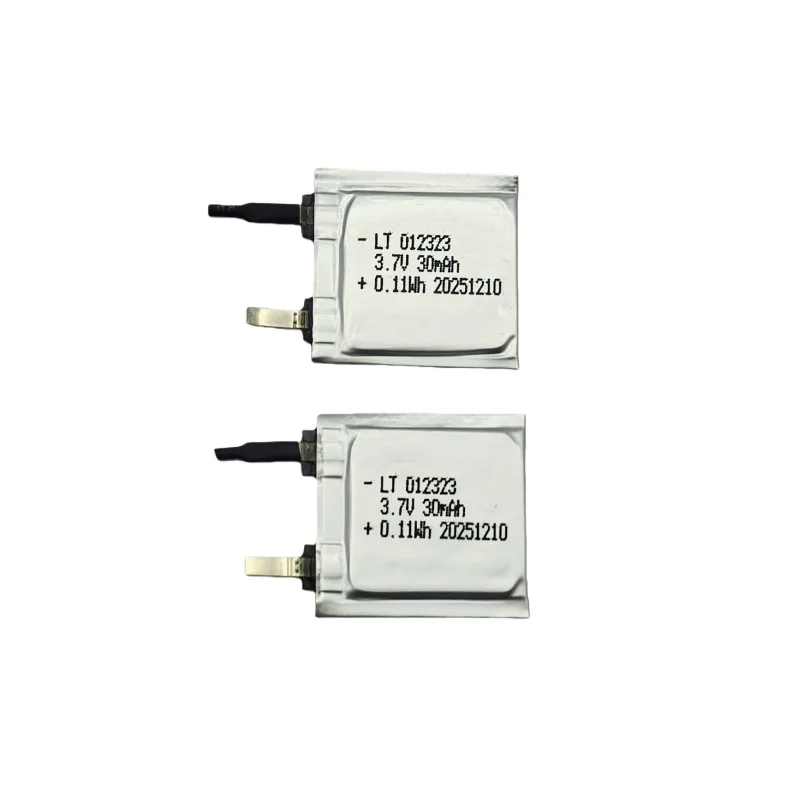
You ask for a price quote. The supplier sends a number. You compare three quotes and pick the lowest. Weeks later, things start going wrong.
The biggest mistake when choosing a UAV battery supplier is treating it as a price comparison. The real decision is about application fit, batch quality consistency, and how well the supplier can support you from sample to mass production. Price only makes sense after those questions are answered.
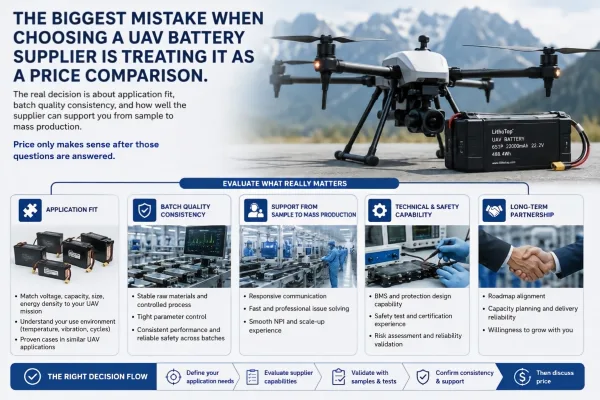
I talk to UAV and RC product teams almost every week. One pattern shows up more than any other. The first message is almost always the same: "What is your price for a battery with X mAh?" No mention of the aircraft size. No mention of flight time targets. No mention of discharge demands or structural constraints. Just a number request. I understand why buyers start there. Budget is real. But starting with price before defining the application is exactly where the risk begins.
Are You Asking the Right First Question?
Most buyers open with price. But price without context is just a number with no meaning attached to it.
The right first question is not "how much does this battery cost?" It is "what does this battery need to do, in what space, at what weight, under what discharge load, and at what production stage?" Once those answers are clear, price becomes something you can actually evaluate.
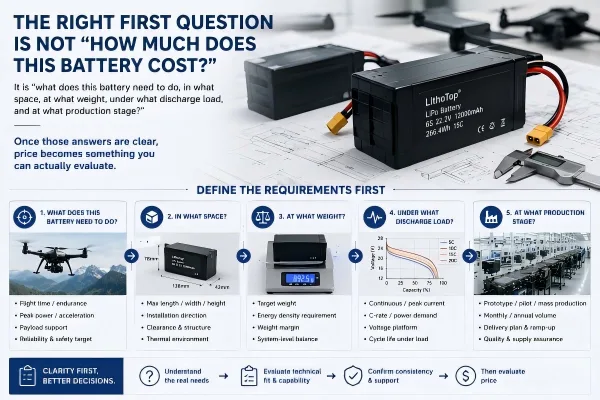
The real issue is that a wrong battery is not just expensive. It is a risk that spreads across your whole product. A battery that is slightly too heavy shifts your center of gravity. A cell that cannot handle burst discharge heats up under load[^1]. A pack that fits the CAD model but not the real assembly slot creates rework at the line. None of these problems show up in a price quote.
When I work through requirements with a UAV customer, the conversation usually covers at least these areas:
What Does Your Application Actually Demand?
| Parameter | Why It Matters |
|---|---|
| Flight task type | Hovering, fast forward flight, and heavy-lift tasks have very different average and peak current demands |
| Target flight time | Sets the minimum usable capacity after accounting for safety reserve |
| Physical space | Determines cell format: pouch, cylindrical, or prismatic, and whether a curved or ultra-thin form is possible |
| Total weight budget | Battery weight directly trades against payload and flight time |
| Discharge profile | Continuous C-rate and burst C-rate together determine cell selection |
| Production stage | Sample, pilot, or mass production changes what a supplier needs to prepare |
These six areas are not a checklist for engineers only. They are the minimum context a supplier needs to give you a useful answer. If a supplier is willing to quote you without asking any of these questions, that itself tells you something important about how they work.
Going deeper: cell selection inside a battery pack is not a single decision. The same 5000 mAh capacity target can be reached with different cell chemistries, form factors, and configurations, each with different weight outcomes, thermal behavior, and cost points. A supplier who jumps straight to price is skipping all of this. They are likely quoting you a stock configuration that may or may not match your platform. The right approach is to work backward from your flight requirement to the cell specification, not the other way around.
Is Your Supplier Actually Helping You Think Through Trade-offs?
A battery supplier who only sells stock is not the same as a supplier who helps you make better design decisions. The difference matters more than most buyers realize.
A good UAV battery supplier should be able to help you think through trade-offs between endurance, burst power, weight, structural format, and production feasibility. If a supplier can only respond to your spec sheet without adding any technical input, you are carrying all the risk yourself.
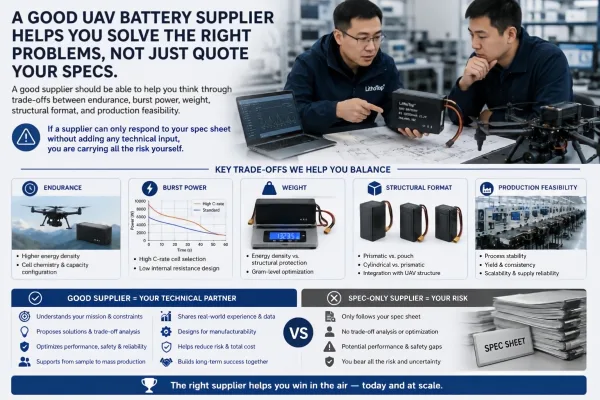
This is where the supplier relationship either creates value or just fills orders. I have seen buyers come in with a specification that technically checks out on paper but is difficult to manufacture consistently at scale. A supplier with real production experience will flag that early. One without that experience will accept the spec, produce the sample, and leave the problem for mass production.
What Good Technical Support Looks Like at Each Stage
| Stage | What You Should Expect from a Good Supplier |
|---|---|
| Requirement discussion | Asks about flight task, size, weight, discharge, and production stage before quoting |
| Spec review | Identifies constraints or conflicts in your requirements before sampling starts |
| Sample development | Communicates build decisions and trade-offs, not just delivers a finished pack |
| Sample validation | Supports your testing and helps interpret results that are borderline |
| Mass production | Maintains same cell lot, same BMS configuration, and same QC process as validated sample |
The trade-off conversation is where experience becomes visible. Capacity versus weight, burst discharge versus cycle life[^2], compact form factor versus thermal management space — these are real tensions that need to be worked through. A supplier who has done this work before with UAV and RC customers will know where the difficult points are. They will bring those points to you before they become problems.
For reference, our team at LithoTop works through these trade-offs as a standard part of pre-sales communication for every custom battery project. We ask about application before we discuss specification.
What Risks Show Up After the Sample Is Approved?
Most procurement risk conversations stop at sample approval. But a passed sample is not the end of the evaluation. It is the beginning of a longer test.
The real procurement risk in UAV battery sourcing often appears during and after mass production: batch-to-batch consistency, QC process stability, and communication quality under delivery pressure[^3]. These factors affect your brand reputation and after-sales cost more than the unit price does.
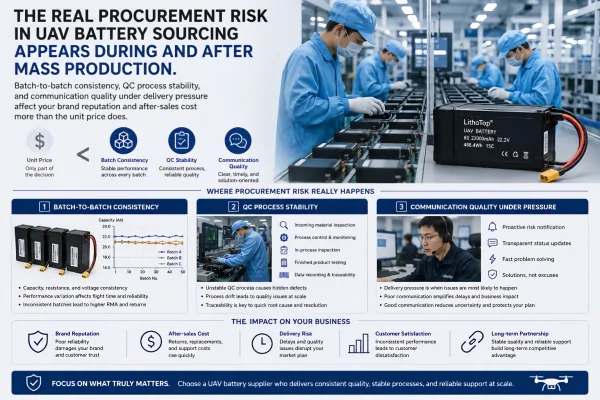
I want to be clear about something. A low price alone does not make a supplier unreliable. The problem is low price without a clear picture of what production process and quality management sits behind it. When production pressure increases, what gets maintained and what gets cut is a direct function of how the supplier manages their line.
Quality Risk Areas to Evaluate Before You Commit
| Risk Area | What to Look For |
|---|---|
| Cell sourcing consistency | Does the supplier use the same cell brand and lot across batches, or switch based on availability? |
| BMS configuration control | Is the BMS spec locked to your validation, or subject to component substitution? |
| QC structure | Does the supplier have dedicated IQC, IPQC, FQC, and OQC processes, or rely on end-of-line spot checks? |
| Production capacity | Can their daily output support your volume without pushing quality shortcuts? |
| Communication under pressure | When there is a delivery timeline issue, do they communicate early or disappear? |
These are not theoretical concerns. They are the points where the gap between a sample result and a production result actually opens up. A supplier with stable QC management, clear cell sourcing records, and a locked BMS configuration will produce consistent results across batches. A supplier without those structures will produce results that drift.
Going deeper: quality in battery production is not only about the final test result. It lives in the process. At LithoTop, we implement 5S production management and maintain a dedicated QC team of 15 engineers covering every stage from incoming material to outgoing product. That kind of structure is what keeps a validated sample result consistent across a 10,000-unit production run. When you evaluate a supplier, asking about their QC structure is not a bureaucratic question. It is the most direct question you can ask about production risk.
How Do You Identify a Supplier Worth Trusting?
Not every supplier presents themselves the same way. Some signal their capability clearly. Others only become visible through what they do not say or do not ask.
You can identify a trustworthy UAV battery supplier through specific, checkable signals: they ask about your application before quoting, they explain their QC and batch consistency process clearly, and they show consistent support from sample through to mass production without changing the communication standard.
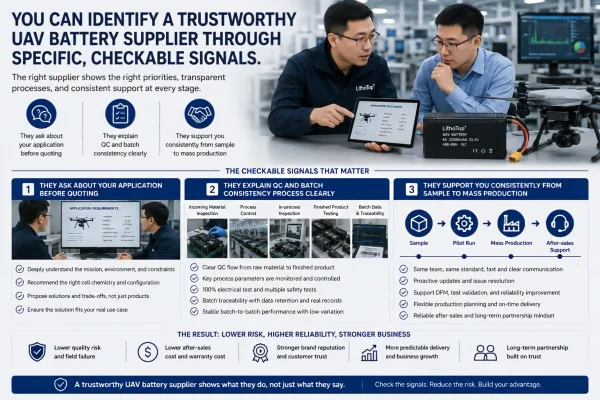
This is not about choosing the supplier with the most certifications listed on their website. Certifications matter, and any serious supplier working with UAV applications should be able to provide CE, UN38.3, and relevant safety certifications as required. But certification is a floor, not a differentiator. What differentiates a supplier is how they behave in the parts of the process that are not documented in a certificate.
Checkable Signals When Evaluating a UAV Battery Supplier
| Signal | What It Tells You |
|---|---|
| They ask about your application first | They understand that specification follows requirement, not the other way around |
| They explain trade-offs before finalizing spec | They have production experience and are not just taking orders |
| They describe their QC process in specific terms | They have a real process, not just a quality promise |
| They confirm what changes and what stays locked at mass production | They understand consistency risk and manage it explicitly |
| They respond clearly when requirements are outside their capability | They are honest about fit, not just trying to close the sale |
| They provide relevant certifications for your target market | They support your compliance requirement, not just their own |
For UAV and RC applications specifically, I would add one more signal: has the supplier worked with similar discharge profiles before? High-burst-demand applications stress cells differently from low-draw IoT devices. A supplier with direct UAV and RC experience will understand your performance requirements faster and flag risks earlier.
At LithoTop, we have worked with UAV brands, RC airplane and helicopter manufacturers, and drone product teams across Europe, North America, and Asia. That experience shows up in how we ask questions at the start of a project, not just in what we deliver at the end.
Conclusion
Choosing a UAV battery supplier is a risk decision, not a price comparison. The right supplier asks the right questions first, supports your trade-offs with real experience, and keeps quality consistent from sample to mass production.
[^1]: "Understanding the Heat Generation Mechanisms and ...", https://www.osti.gov/servlets/purl/2474727. Electrochemical studies of lithium-ion cells demonstrate that heat generation during discharge is governed by ohmic losses (I²R) and entropic heat, both of which increase significantly at elevated discharge rates, contributing to thermal stress and potential degradation. Evidence role: mechanism; source type: paper. Supports: That lithium cells generate heat proportional to discharge current, particularly when operated at or beyond rated C-rate limits, due to internal resistance and electrochemical losses. Scope note: The precise thermal response depends on cell chemistry, form factor, and thermal management design; the claim as stated is directionally accurate but not quantitatively specific. [^2]: "Unraveling capacity fading in lithium-ion batteries using ... - PMC - NIH", https://pmc.ncbi.nlm.nih.gov/articles/PMC10504543/. Electrochemical aging studies have demonstrated that high discharge C-rates accelerate lithium plating, SEI layer growth, and mechanical stress on electrode materials, resulting in faster capacity fade and reduced cycle count compared to cells cycled at lower rates. Evidence role: mechanism; source type: paper. Supports: That repeated high-rate discharge accelerates capacity fade and reduces the usable cycle life of lithium-ion cells compared to lower-rate operation. Scope note: The relationship between C-rate and cycle life is chemistry- and temperature-dependent; the claim holds as a general principle but specific cycle-life reductions vary by cell design. [^3]: "Detecting faulty lithium-ion cells in large-scale parallel battery packs ...", https://pmc.ncbi.nlm.nih.gov/articles/PMC12823614/. Studies of lithium-ion cell manufacturing have identified that process parameter variation across production batches—including electrode coating uniformity, electrolyte fill volume, and formation cycling—contributes to measurable cell-to-cell and batch-to-batch differences in electrochemical performance. Evidence role: mechanism; source type: paper. Supports: That lithium battery manufacturing processes are subject to batch-to-batch variation that can affect cell capacity, internal resistance, and cycle life consistency. Scope note: The magnitude of batch variation depends heavily on the manufacturer's process control maturity; the claim is directionally supported but not universally quantified in the literature.