We receive dozens of inquiries every month from product managers asking for batteries under 2mm thick. They have locked industrial designs, tight launch deadlines, and expect us to deliver custom ultra-thin cells at standard pricing. Most underestimate the real costs and timelines involved in ultra-thin battery development.
Ultra-thin LiPo batteries under 3mm are possible, but they require custom tooling, 1-3 month lead times[^1], and compromise on capacity and cost. The real question is not how thin you can go, but whether ultra-thin design fits your project timeline, budget, and performance requirements.
We work with wearable device brands, medical equipment developers, and IoT product teams who face the same challenge. They need smaller devices, but the battery must still power the product for a full day. I will walk you through what ultra-thin really means in practice and help you decide if it makes sense for your project.
Why Are More Companies Asking for Ultra-Thin LiPo Batteries?
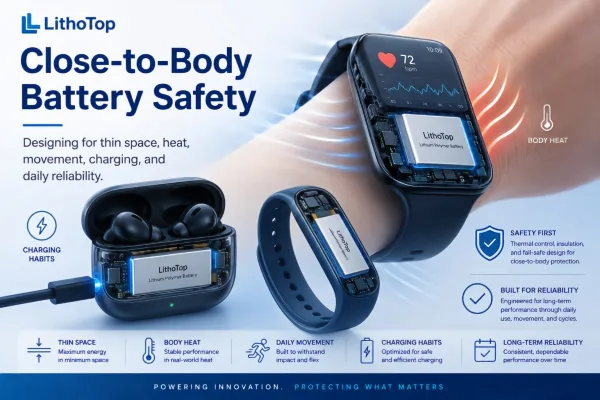
Consumers expect thinner devices. Smartwatches, hearing aids, and fitness trackers compete on comfort and aesthetics. If your product is bulkier than the competitor, it loses shelf appeal. Product teams respond by shrinking every component, including the battery.
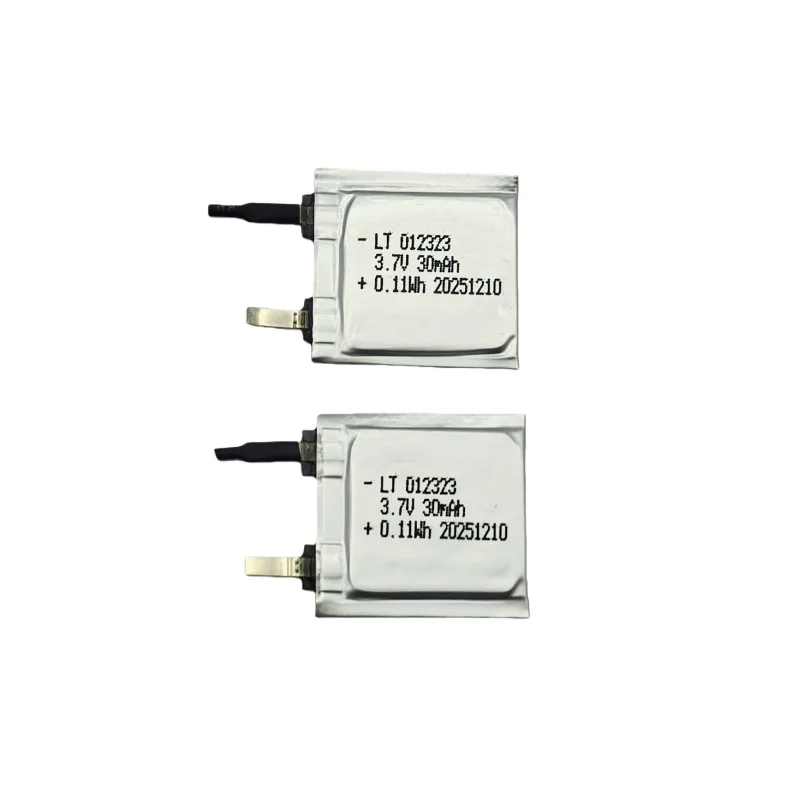
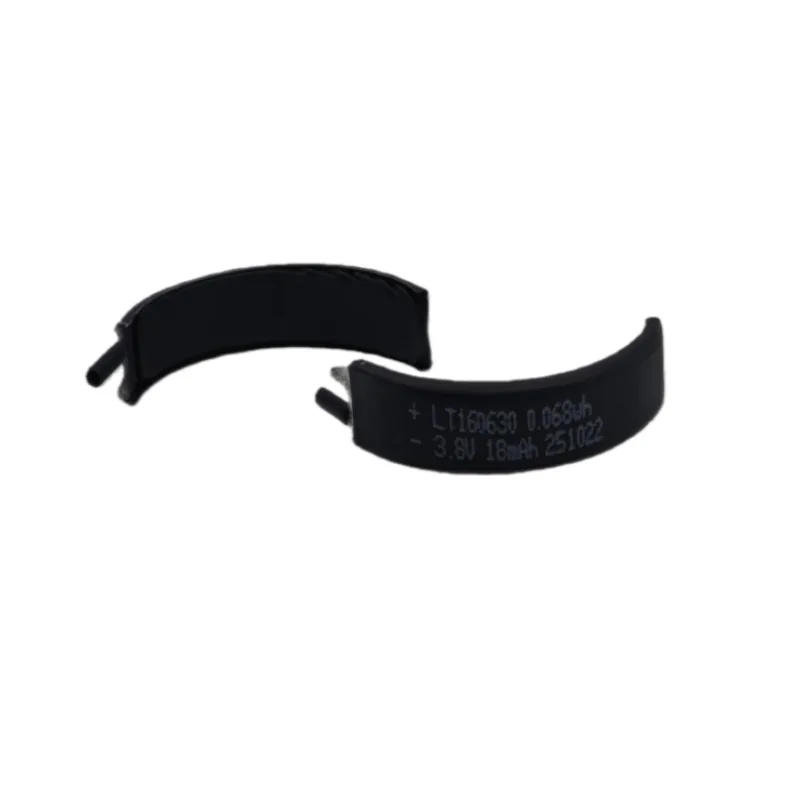
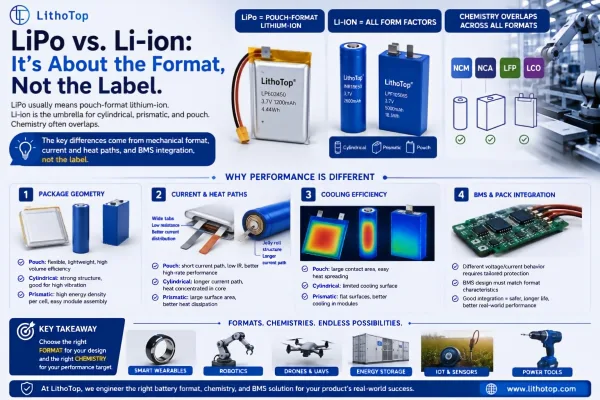
Ultra-thin LiPo batteries, typically defined as cells under 3mm thick, enable devices to fit into spaces that standard batteries cannot occupy. They allow curved designs, reduce device weight, and improve user comfort in wearable applications.
We see three main groups pushing for ultra-thin designs. Wearable brands need batteries that conform to wrist curves or fit behind small displays. Medical device makers must meet strict size limits for implantable or skin-contact products. IoT hardware teams want to embed sensors into credit-card-sized housings. Each group faces the same tradeoff: thinner batteries mean less energy storage per unit volume. A 2mm cell holds less capacity than a 4mm cell with the same footprint. You gain form factor flexibility but lose runtime. The key question is whether your product can operate within that capacity limit or if you need to adjust your industrial design to accommodate a slightly thicker cell.
What Drives the Thickness Requirement in Your Product?
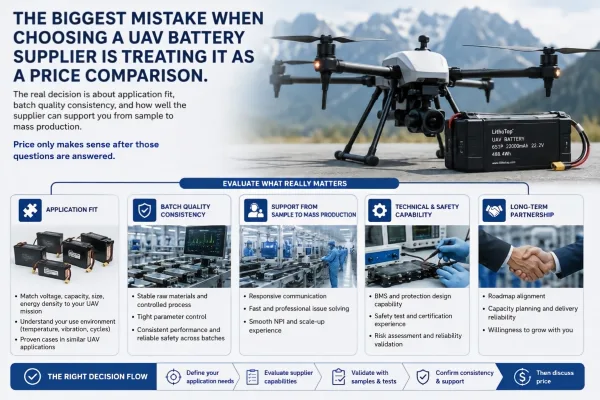
We ask every client to explain why they chose their thickness target. Some have medical certification requirements that limit device profile. Others copied a competitor's dimensions without checking if the battery inside is custom or off-the-shelf. A few locked their industrial design before consulting battery suppliers and discovered too late that their target thickness requires expensive custom development. If you have flexibility in your design phase, you can avoid these issues. A product that allows 3.5mm instead of 2.5mm can use a semi-custom or even stock battery, cutting lead time from four months to three weeks and reducing unit cost by 30-40%. But if your thickness is fixed due to regulatory, ergonomic, or competitive constraints, then custom ultra-thin is your only path. We help you map out what that path looks like in terms of timeline, cost, and technical risk.
| Thickness Range | Battery Type | Lead Time | Relative Cost | Typical Use Case |
|---|---|---|---|---|
| 5mm+ | Standard off-the-shelf | 1-2 weeks | Baseline | General consumer electronics |
| 3-5mm | Semi-custom | 3-4 weeks | 1.2-1.5x | Compact IoT devices, portable tools |
| 2-3mm | Custom ultra-thin | 1-3 months | 1.8-2.5x | Slim wearables, medical patches |
| Under 2mm | Fully custom R&D | 2-3 months | 3x+ | High-end wearables, niche medical |
Your industrial design team should involve the battery supplier before finalizing enclosure dimensions. We have worked on projects where a 0.5mm increase in allowed thickness doubled the available capacity and cut the project cost in half. That small design compromise delivered better battery life and faster time to market.
What Are the Real Costs of Going Ultra-Thin?
Clients often focus on unit price. They compare our quote for a custom 2mm cell to the price of a standard 4mm cell and ask why the difference is so large. The answer is that ultra-thin batteries require custom tooling, specialized production processes, and longer quality validation cycles.
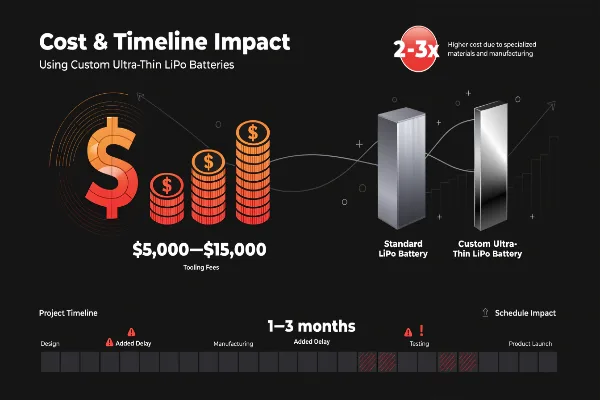
Custom ultra-thin LiPo batteries typically cost 2-3 times more per unit than standard cells[^2] of similar capacity, and they add $5,000-$15,000 in tooling fees plus 3-6 months to your project timeline.
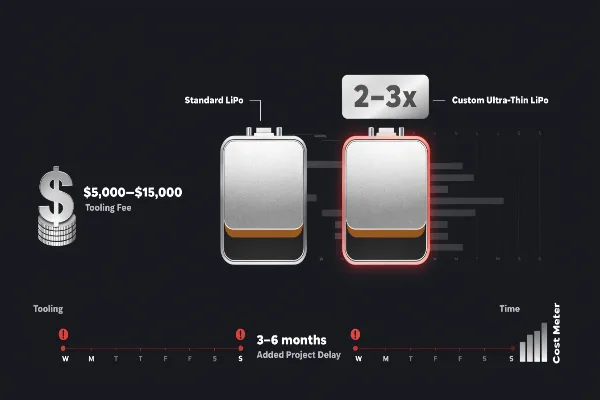
We break down the cost structure for every client so they can make informed decisions. First, there is tooling cost. A custom cell shape or thickness requires new molds and jigs. This is a one-time fee, but it ranges from $5,000 to $15,000 depending on complexity. If you plan to order 10,000 units, the tooling cost per unit is $0.50 to $1.50. If you only need 1,000 units for a pilot run, the tooling cost per unit jumps to $5 to $15, which can make your project uneconomical. Second, there is development time. We need to produce sample cells, test them under your operating conditions, adjust the design if performance does not meet requirements, and produce a second round of samples. This cycle takes 6-8 weeks for the first iteration and 4-6 weeks for each additional iteration. If your product launch is in three months, custom ultra-thin will not fit your timeline. Third, there is certification delay. Ultra-thin cells often require additional safety testing because thinner separators and electrodes increase the risk of short circuits under mechanical stress. If your target market requires UL, IEC, or medical device certifications, expect an extra 2-4 months for testing and documentation. We have seen projects delayed by six months because the client did not account for certification timelines when they committed to a product launch date.
How Does Unit Price Scale with Order Volume?
Unit price drops as order volume increases, but the pricing curve for custom ultra-thin batteries is steeper than for standard cells. A standard 4mm cell might cost $2 at 1,000 units and $1.50 at 10,000 units. A custom 2mm cell might cost $6 at 1,000 units and $3.50 at 10,000 units. The percentage drop is similar, but the absolute price remains higher because the production process is more labor-intensive and yields are lower. We advise clients to plan for minimum order quantities of 5,000-10,000 units to make custom ultra-thin economically viable. Below that threshold, you should consider whether a semi-custom or even off-the-shelf battery with adjusted product design might deliver better overall project economics.
| Order Volume | Standard 4mm Cell | Custom 2-3mm Cell | Fully Custom <2mm Cell |
|---|---|---|---|
| 500 units | $2.50 | $7.00 | $12.00 |
| 1,000 units | $2.00 | $6.00 | $10.00 |
| 5,000 units | $1.70 | $4.50 | $7.00 |
| 10,000 units | $1.50 | $3.50 | $5.50 |
| 50,000+ units | $1.30 | $2.80 | $4.20 |
We ask clients to share their projected order volume for the first year and the next two years. If the total volume is under 10,000 units, we recommend exploring design adjustments that allow a thicker, more cost-effective battery. If the volume is 50,000+ units, the unit price savings from standard cells may not justify the competitive disadvantage of a bulkier product.
What Capacity Can You Expect from Ultra-Thin Cells?
Thinner batteries hold less energy. This is a hard physical limit. A 2mm cell with a 30mm x 40mm footprint might deliver 200-250mAh. A 4mm cell with the same footprint can deliver 500-600mAh. If your product needs 8 hours of runtime and the electronics draw 50mA, you need at least 400mAh. A 2mm cell will not work unless you redesign the electronics to reduce power consumption or accept shorter runtime.
Ultra-thin LiPo batteries under 3mm typically deliver 50-70% less capacity than standard cells with the same footprint[^3]. You must either redesign your electronics for lower power draw, reduce runtime requirements, or increase battery footprint to compensate.
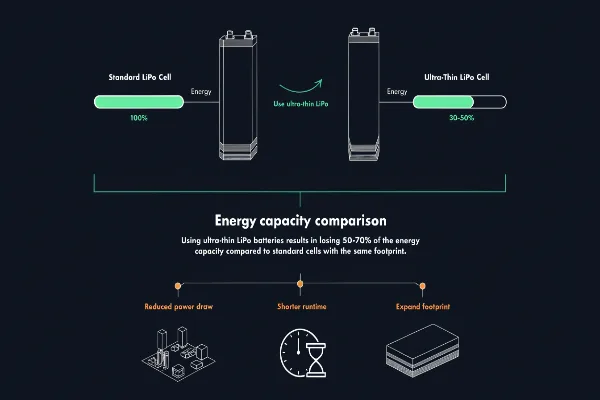
We calculate capacity requirements with every client before quoting a battery specification. We ask for the average current draw, peak current draw, and required runtime. Then we calculate the minimum capacity needed and compare it to what an ultra-thin cell can deliver within the available space. If there is a gap, we discuss three options. First, can you reduce power consumption? Some clients switch to more efficient microcontrollers, lower display brightness, or optimize software to extend runtime. Second, can you increase battery footprint? An extra 5mm in length or width can add 30-50mAh, which might close the gap. Third, can you accept shorter runtime? Some wearable devices are designed for 6 hours of active use instead of 8, with the assumption that users will recharge during the day. We do not make the decision for you, but we help you understand the tradeoffs so you can make an informed choice.
How Do You Balance Capacity, Thickness, and Footprint?
Capacity is a function of three dimensions: thickness, length, and width. If thickness is fixed, you can only increase capacity by expanding footprint. But footprint is often constrained by industrial design or user comfort. A smartwatch that is too wide or too long becomes uncomfortable to wear. We work with clients to find the optimal balance. Sometimes a slightly curved cell can fit more capacity into the same perceived footprint by better utilizing the available space. Other times, a rectangular cell with rounded corners improves safety and durability without sacrificing capacity. We produce custom shapes including curved, cylindrical, and irregular polygons. Each shape has manufacturing implications, but they all follow the same principle: you get the most capacity by maximizing the total volume occupied by active materials within your available space.
When Should You Engage a Battery Supplier?
Most clients contact us after finalizing their industrial design. They have CAD files, prototypes, and locked dimensions. They expect us to fit a battery into the remaining space. This approach creates problems. The available space is often too small, oddly shaped, or located in a high-temperature zone that limits battery performance. We can still deliver a solution, but it is more expensive and takes longer than necessary.
You should engage a battery supplier during the concept phase, before finalizing industrial design. Early collaboration allows you to optimize device layout, battery placement, and thermal management, reducing cost and lead time by 30-50%.
We prefer to join the project during concept development. You share your target device size, expected runtime, and operating environment. We provide preliminary battery specifications and suggest layout options that optimize cost, performance, and manufacturability. You incorporate our input into your industrial design, leaving enough space for a battery that meets your requirements without requiring expensive custom development. This approach saves time and money. Clients who engage us early typically launch 2-3 months faster and spend 30-40% less on battery procurement than those who contact us after locking their design. We have worked with medical device startups that brought us in during the initial product definition phase. They had flexibility in enclosure design and were willing to adjust dimensions by a few millimeters to accommodate a more cost-effective battery. The result was a product that met all performance requirements, passed regulatory testing on the first attempt, and launched on schedule within budget.
What Questions Should You Ask Your Battery Supplier Early?
We recommend asking five questions during initial discussions. First, what is the minimum thickness that can deliver my required capacity within my available footprint? This tells you if your current design is feasible or if you need to adjust dimensions. Second, what is the typical lead time for a battery with my specifications? This helps you plan your product development timeline and identify potential bottlenecks. Third, what certifications will I need, and how long do they take? This prevents surprises later when you discover that your target market requires certifications you did not budget for. Fourth, what is the tooling cost, and at what order volume does it become economical? This helps you decide if custom ultra-thin makes sense for your projected sales. Fifth, can you provide samples for testing before I commit to tooling? This allows you to validate battery performance in your actual product before investing in custom development. We answer all five questions in our initial consultation and provide a preliminary quote that includes unit price, tooling cost, lead time, and certification recommendations. This gives you the information you need to make a go or no-go decision on ultra-thin design.
What Are the Safety Considerations for Ultra-Thin Batteries?
Thinner cells are more vulnerable to mechanical stress. A 2mm battery has less structural rigidity than a 4mm battery. If your product experiences drops, impacts, or bending forces, the thinner cell is more likely to deform, which can cause internal short circuits. We address this risk through protective measures, but each measure adds cost or reduces capacity.
Ultra-thin LiPo batteries require additional mechanical protection, such as rigid backing plates or reinforced packaging, to prevent deformation and short circuits under stress. These protections add 0.2-0.5mm to total thickness and reduce usable capacity by 5-10%.
We discuss safety requirements with every client based on their use case. Wearable devices that experience frequent impacts need more protection than stationary IoT sensors. Medical devices that contact skin require additional insulation and fail-safe mechanisms. We offer several protective options. A rigid backing plate adds 0.3-0.5mm but prevents cell deformation during drops. Reinforced pouch material increases puncture resistance but reduces energy density by 5-8%. Integrated protection circuits add cost but prevent overcharge, over-discharge, and short-circuit conditions. We help you select the right combination of protections based on your risk tolerance, budget, and performance requirements. Some clients choose minimal protection to maximize capacity and accept the risk of slightly higher failure rates. Others prioritize safety and accept the capacity tradeoff. We do not make the decision for you, but we provide failure rate data and testing results so you can make an informed choice.
What Testing Should You Perform on Ultra-Thin Batteries?
We recommend three types of testing before mass production. First, drop testing. Place the battery in your product enclosure and drop it from typical use heights. Check for deformation, capacity loss, or internal resistance changes. Second, thermal cycling. Expose the battery to your expected operating temperature range and measure performance degradation over time. Third, charge-discharge cycling. Run the battery through 300-500 full cycles at your actual operating current to verify that it meets your lifetime requirements. We provide sample cells for all three tests and help you interpret the results. If the samples fail any test, we adjust the design and produce a second round of samples. This iteration process takes time, which is why we emphasize starting early in your product development cycle.
How Do Certifications Affect Your Ultra-Thin Battery Timeline?
Certifications are often the longest part of the project timeline. If your target market is North America, you may need UL certification. If it is Europe, you need CE and possibly IEC 62133[^4]. Medical devices require additional certifications depending on the regulatory class. Each certification involves testing, documentation, and review by external agencies.
Ultra-thin LiPo batteries for consumer and medical devices typically require 2-4 months for certification testing and approval, which must be factored into your product launch timeline.
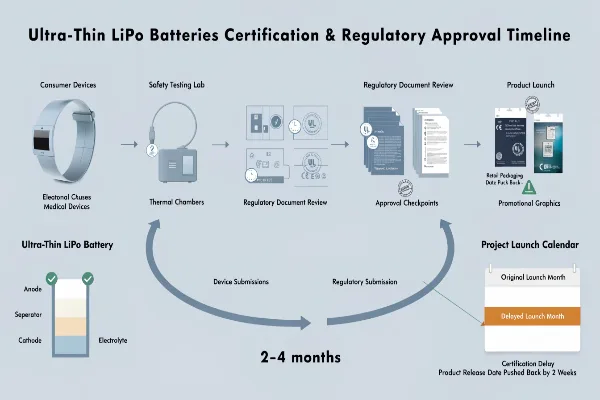
We handle certification coordination for clients, but the process still takes time. UL 1642 testing for lithium batteries includes short-circuit, overcharge, crush, and thermal abuse tests. Each test requires multiple samples and takes 1-2 weeks. If a sample fails, we must adjust the design, produce new samples, and retest, which adds another 4-6 weeks. CE marking requires a technical file with safety data, manufacturing process documentation, and compliance declarations. IEC 62133 is similar but has additional requirements for battery packs. Medical device certifications add another layer of complexity because you must demonstrate biocompatibility, sterilization compatibility, and long-term reliability. We advise clients to start the certification process as soon as the battery design is finalized, even before mass production begins. This parallelizes the timeline and reduces the risk of launch delays. We have worked with clients who waited until mass production to start certification and discovered that their launch date was four months too optimistic.
[^1]: "Current and future lithium-ion battery manufacturing - PMC", https://pmc.ncbi.nlm.nih.gov/articles/PMC8050716/. Custom lithium-ion battery development typically involves prototyping, testing, and tooling phases that extend project timelines, though specific durations vary by manufacturer and complexity. Evidence role: general_support; source type: research. Supports: typical lead times for custom battery development in the lithium-ion industry. Scope note: General industry timelines rather than specific verification of the 3-6 month range for sub-3mm cells [^2]: "[PDF] Cost Analysis and Projections for U.S.-Manufactured Automotive ...", https://publications.anl.gov/anlpubs/2024/01/187177.pdf. Custom battery development involves tooling, lower production volumes, and specialized processes that increase per-unit costs compared to standardized cells, though exact multipliers depend on specifications and order quantities. Evidence role: general_support; source type: research. Supports: cost premiums associated with custom battery manufacturing. Scope note: General cost factors rather than specific verification of the 2-3x multiplier [^3]: "Battery Data | Center for Advanced Life Cycle Engineering", https://calce.umd.edu/battery-data. Battery capacity scales approximately linearly with thickness when footprint is constant, as the volume of active materials determines total charge storage, though exact reductions depend on cell chemistry and design. Evidence role: statistic; source type: research. Supports: capacity reduction in thinner battery form factors. Scope note: General scaling relationship rather than specific verification of the 50-70% range [^4]: "IEC 62133-2:2017", https://webstore.iec.ch/en/publication/32662. IEC 62133 is an international safety standard for portable sealed secondary lithium cells and batteries, specifying requirements and tests for safe operation under normal use and reasonably foreseeable misuse. Evidence role: definition; source type: institution. Supports: the scope and purpose of IEC 62133 as a battery safety standard.